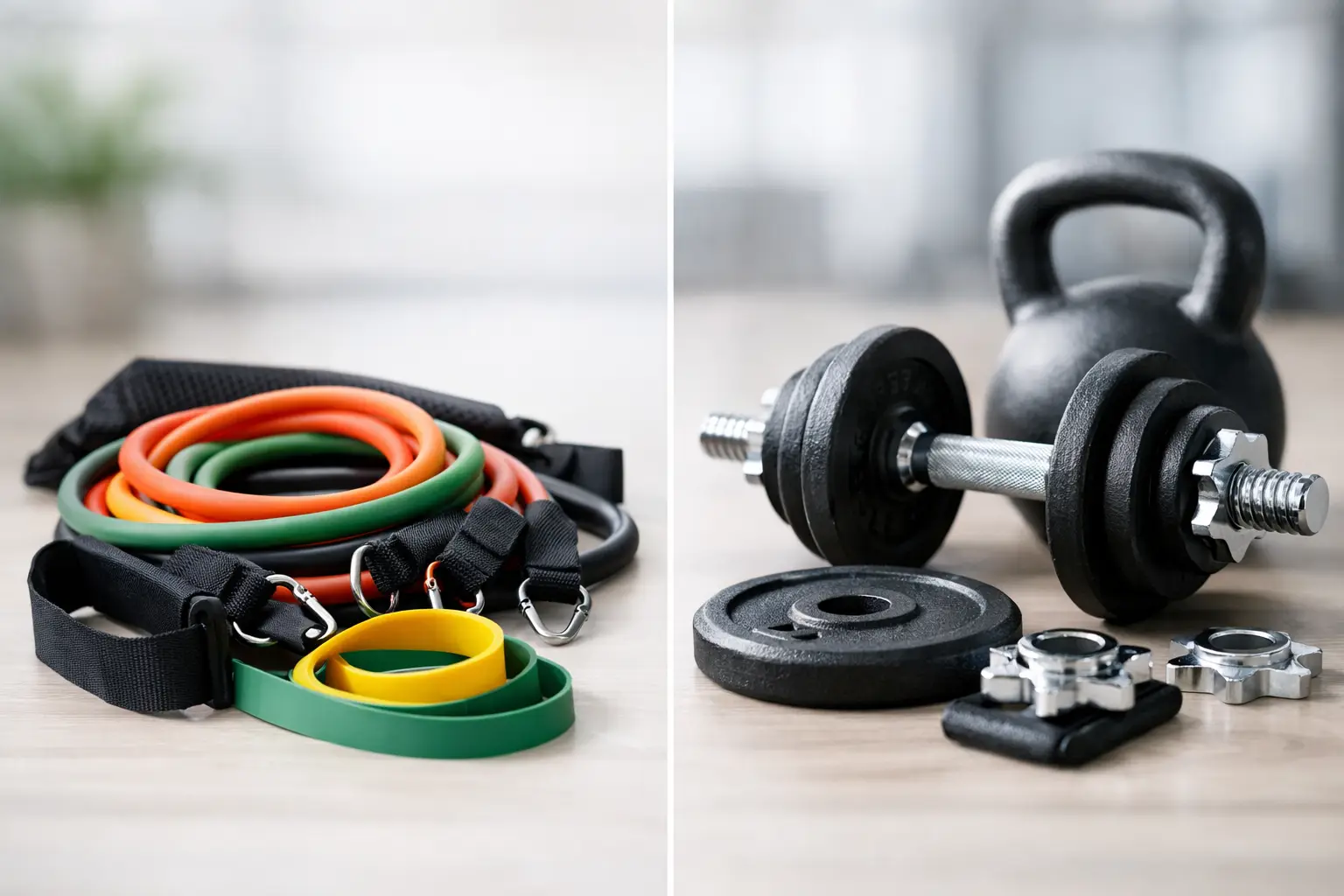
You do not need a garage full of iron to get stronger, and you do not need to pretend a loop band can do everything a dumbbell can. The real answer to resistance bands vs weights comes down to your goal, your training style, and how much convenience matters when life gets busy. If you want results without wasting money on gear that does not fit your routine, this is the comparison that matters.
Resistance bands vs weights: the real difference
At the simplest level, weights use gravity to create resistance, while bands create tension as they stretch. That sounds minor, but it changes how each tool feels during a rep.
With dumbbells, kettlebells, barbells, or plates, the load is consistent and easy to measure. A 25-pound dumbbell is always 25 pounds. That makes progressive overload more straightforward, which is a big deal if your main target is building serious strength or tracking clear performance gains over time.
Bands feel different because resistance increases as the band stretches. Early in the movement, the load may feel lighter. Near the top, it can feel much harder. That variable resistance can be useful, especially for glute work, shoulder training, mobility drills, and adding challenge to bodyweight moves. It can also feel less natural for some exercises if you are used to lifting with fixed loads.
Neither option is automatically better. They simply stress the body in different ways.
Which is better for muscle growth?
If your goal is hypertrophy, both bands and weights can work. The question is how far you want to take it.
Weights usually have the edge for muscle growth because they make it easier to load major movement patterns heavily and progressively. Squats, presses, rows, deadlifts, lunges, and carries are simple to scale when you can add more pounds. That matters for intermediate and advanced lifters who need a stronger stimulus to keep growing.
Bands can still build muscle, especially for beginners, people returning from a layoff, or anyone training at home with limited space. High-rep band presses, rows, curls, lateral raises, glute bridges, and kickbacks can absolutely create fatigue and tension. If you train close to failure and stay consistent, bands are more effective than many people assume.
The trade-off shows up when your strength improves. At some point, it becomes harder to challenge big lower-body and pushing movements enough with bands alone. You can stack bands or change angles, but it is not always as clean or as motivating as moving to a heavier dumbbell or plate.
Which is better for strength?
For raw strength, weights are the stronger pick.
That is not marketing hype. It is just easier to build maximal force production when the load is stable, measurable, and heavy enough to push your limit safely. If you care about getting stronger on compound lifts, weights give you more room to progress in a structured way.
Bands can improve strength too, especially in beginners. They also help with control, joint stability, and speed through certain ranges of motion. Athletes often use them for accessory work, warm-ups, and power-focused drills. But if your definition of strength is lifting heavier over time, weights usually move you there faster.
What feels better on your joints?
This is where bands earn a lot of fans.
Resistance bands tend to be more forgiving on the joints because the load is often lower at the weakest point of the movement. That can make presses, pull-aparts, leg extensions, hamstring curls, and rehab-style exercises feel smoother. For people managing shoulder irritation, elbow discomfort, or knee sensitivity, bands can be a smart way to keep training without beating up the body.
Weights are not bad for your joints by default. Poor technique, bad programming, and loading too much too soon usually cause the problem. In fact, well-executed strength training with weights can improve joint health over time by building muscle, bone density, and connective tissue resilience.
So if you need the gentler option right now, bands often win. If you want long-term structural strength and can train with good form, weights still belong in the picture.
Resistance bands vs weights for home workouts
For home gyms, this is where the decision gets more personal.
Bands are hard to beat for convenience. They are light, cheap, easy to store, and travel-friendly. You can keep a full set in a drawer, take them on work trips, and train in a small apartment without turning your living room into a weight room. For busy professionals and beginners who want zero setup friction, that matters.
Weights take more commitment. Adjustable dumbbells, kettlebells, benches, and plate sets cost more and take up more space, but they also create a more complete training setup. If your plan is to train consistently for months and years, that investment often pays off because you are less likely to outgrow the equipment.
If budget and square footage are tight, bands are the fast-start option. If you are building a serious home setup, weights usually offer more long-term upside.
What about fat loss?
Bands do not burn fat better than weights, and weights do not have a magic edge either. Fat loss comes mostly from a calorie deficit supported by training that helps you keep muscle.
That said, weights often make it easier to preserve or build lean mass while dieting, which can support better body composition. Bands can absolutely play a role too, especially if they help you stay consistent. The best tool for fat loss is the one you will actually use four days from now, not the one that sounds toughest on paper.
For many people, the winning setup is a mix of resistance training, some cardio, enough daily movement, and nutrition that matches the goal. Gear supports the plan. It is not the plan.
When bands are the smarter buy
Bands are a strong call if you are just getting started, training in a small space, rebuilding after time off, or want affordable versatility without a big commitment. They are also a smart add-on if you already train with weights and want better warm-ups, activation work, burnout sets, or portable options for travel days.
They shine for glute training, shoulder health, mobility sessions, and home workouts where simplicity wins. If you want a low-cost entry point that still delivers real work, bands are one of the best-value tools in fitness.
That is why they show up so often in hot picks and best-seller home training setups. They solve a real problem fast.
When weights are worth it
Weights make more sense if your goals are centered on getting significantly stronger, building more muscle, or creating a training setup that can keep challenging you for years. They are also the better fit if you enjoy tracking numbers and seeing concrete progression from week to week.
A pair of adjustable dumbbells can cover a surprising amount of ground. Add a bench or kettlebell and your exercise options open up even more. For shoppers who want measurable progress and equipment they will not outgrow quickly, weights are often the must-have deal, even at a higher upfront cost.
If you are serious about home strength training, this is usually where the smarter long-term money goes.
The best answer for most people: use both
This is the part that gets skipped too often. You do not have to pick a side forever.
Weights handle the heavy lifting for strength and muscle. Bands fill in the gaps with warm-ups, accessory work, mobility, rehab-friendly training, and extra resistance where certain exercises need it most. That combination is practical, effective, and easier to stick with than a rigid all-or-nothing setup.
A simple example looks like this: use dumbbells for squats, rows, presses, and Romanian deadlifts, then use bands for lateral walks, face pulls, triceps pressdowns, and high-rep finishers. You get structure and progression from the weights, plus flexibility and joint-friendly volume from the bands.
For a lot of home gym owners, that is the sweet spot.
How to choose without overthinking it
If you are deciding what to buy first, start with the tool that removes your biggest barrier to training. If your barrier is cost, storage, or travel, go with bands. If your barrier is not feeling challenged enough and wanting clearer progression, go with weights.
If you can stretch the budget a little, a combo setup is hard to beat: a quality band set plus adjustable dumbbells gives you enough variety to train almost every major muscle group effectively at home. That kind of setup fits the way real people train – some days short and efficient, some days heavier and more focused.
FitwellGoods serves exactly that kind of shopper: people who want practical gear, visible progress, and smart value without wasting time on equipment that will collect dust.
The best training tool is not the one that wins a comment section argument. It is the one that fits your space, your budget, your body, and your schedule well enough that you keep showing up. Pick the gear that makes your next workout easier to start, and the results usually follow.