
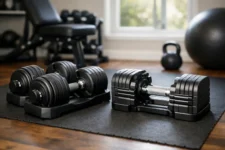
That cheap rack of fixed dumbbells looks great until it eats half your floor space and your workout still stalls at the wrong weights. For most home gyms, adjustable dumbbells are the smarter buy – but only if you pick a set that matches how you actually train.
This adjustable dumbbells review is built for that decision. Not hype, not guesswork, and not a one-size-fits-all answer. If you lift before work, train in a spare bedroom, or want more exercise options without turning your home into a commercial gym, the right pair can save space, speed up your sessions, and give you room to progress.
Adjustable dumbbells review: what really matters
Most shoppers start with max weight, and that makes sense. If the set tops out too low, you will outgrow it fast on rows, presses, goblet squats, and Romanian deadlifts. But max weight is only one piece of the value equation.
The bigger question is how the dumbbells feel during real workouts. A set can offer a huge range on paper and still frustrate you if the handle is awkward, the plates rattle too much, or changing weight takes long enough to cool your heart rate between sets. Convenience is the whole pitch here. If adjustment is annoying, you stop using the feature that justified the purchase.
Durability matters too, especially if your training style is fast-paced. Some adjustable systems are best for controlled strength work, where you move from bench press to curls and keep the dumbbells close to the stand. Others can handle more variety, but even the best adjustable sets usually do not love being dropped. If your workouts include explosive movements or overhead work to fatigue, that trade-off matters.
The biggest pros and trade-offs
The upside is obvious. Adjustable dumbbells replace multiple pairs, which is a major win for apartments, garages, and compact training corners. They also tend to be more budget-friendly than buying a full run of quality fixed dumbbells. If you are building a setup piece by piece, that matters.
They are also great for progression. Instead of making huge jumps, many sets let you increase in small increments. That is useful for beginners learning form and for intermediate lifters trying to keep progress moving on accessory work.
The trade-off is feel. Fixed dumbbells usually win on balance, simplicity, and toughness. Adjustable models often have a longer overall shape, especially at lighter settings, because the housing stays the same size. That can affect movements like hammer curls, lateral raises, and some overhead patterns. It is not always a dealbreaker, but it is one of the most common surprises after purchase.
Which type of adjustable dumbbell is best?
There are three common styles, and your best option depends on how you train.
Dial-based dumbbells are the most convenient for quick weight changes. Turn the dial, lift, and go. They are popular for circuit training and general home workouts because they keep transitions fast. The catch is that they usually have more moving parts, which means you want a stable storage base and controlled handling.
Selector pin models work a little more like a weight stack. They can be very practical and often feel straightforward to use. Some lifters prefer them because the mechanism is easy to understand at a glance, though the look and balance vary by brand.
Plate-loaded handles are the old-school option. You manually add and remove plates with collars. They take longer to adjust, but they can be durable, simple, and often more affordable. If your training is more traditional and you do not mind slower setup between exercises, they still deserve a look.
Adjustable dumbbells review by training goal
Best fit for beginners
If you are newer to strength training, ease of use should be near the top of the list. You want a set that changes quickly, has clear weight markings, and offers manageable jumps. A beginner does not need the heaviest set on the market. A smooth 5- to 50-pound range often covers a lot of progress in presses, rows, squats, split squats, curls, and shoulder work.
The key is consistency. A set that feels inviting and easy to use will help you train more often. That beats buying an oversized, intimidating system that you rarely touch.
Best fit for muscle-building home gyms
If hypertrophy is your main goal, look for enough top-end weight and enough intermediate jumps to keep tension where you want it. For many people, 50 pounds per hand is a solid starting point, but stronger lifters may want 80 or even 90 pounds per dumbbell for chest, back, and lower-body work.
This is where value gets interesting. A heavier adjustable set costs more upfront, but replacing a lighter set six months later usually costs more overall. If you already know you are progressing fast, buy with your next stage in mind.
Best fit for fast-paced training
For supersets, circuits, and short lunch-break workouts, speed is everything. Dial systems often shine here because they keep rest periods tight. If your training style is all about momentum, shaving even 15 to 20 seconds off each adjustment adds up.
Still, be honest about movement style. If you tend to rush, set dumbbells down hard, or move equipment around often, convenience has to be balanced against durability.
How to judge build quality before you buy
A good adjustable dumbbell should feel secure at every weight setting. The handle should be comfortable without forcing your grip too wide or too narrow. Knurling, coating, and overall grip texture can make a big difference once your hands get sweaty.
Check the cradle or base design too. A stable base makes weight changes smoother and lowers the chance of misalignment. If the dumbbell has to be placed perfectly every time just to re-rack, that can get old fast.
Noise is another small detail that becomes a big one over time. Some rattling is normal, but excessive shifting can make a set feel cheap even if it is technically working as intended. During controlled lifts, a little movement is fine. During pressing or carrying patterns, too much play can mess with confidence.
Price, value, and who should spend more
Not every shopper needs the premium option. If you train two or three times a week, mostly use moderate loads, and care most about saving space, a mid-range set may deliver everything you need. That is a strong buy if the mechanism is reliable and the weight range matches your program.
Spending more makes sense when you train often, need heavier loads, or want a faster, smoother user experience. It also makes sense if you share equipment with a partner and both of you need quick changes between exercises. In that case, convenience is not a luxury – it is what keeps the workout moving.
If you are already shopping for a bench, flooring, resistance bands, or recovery gear, it can also pay to think in terms of a full setup instead of one isolated item. That is where category-driven stores like FitwellGoods can help simplify the process and surface hot picks without sending you into research overload.
Common mistakes in an adjustable dumbbells review search
The biggest mistake is buying for your current strongest curl instead of your overall program. Your dumbbells need to work across presses, rows, lower-body patterns, and accessory lifts. A set that feels perfect for arms but caps your bigger movements too early is not really a value win.
The second mistake is ignoring adjustment speed. Product pages make every system sound easy, but your training style tells the truth. If you love giant sets and move fast, a slower system will annoy you every session.
The third mistake is expecting adjustable dumbbells to replace every strength tool. They are excellent, but they are not magic. If you are chasing very heavy lower-body loading or advanced power work, you may still want kettlebells, a barbell, or machines in the long run.
So, are adjustable dumbbells worth it?
For most home gym shoppers, yes. A strong adjustable set gives you more training variety, better use of space, and an easier path to progressive overload than piecing together random fixed pairs over time. That is especially true if your goals include strength, lean muscle, fat loss support, or simply getting more sessions done at home.
The right answer depends on your space, your training pace, and how heavy you realistically need to go. If you want fast changes and convenience, lean toward dial or selector systems. If you want simplicity and durability at a lower cost, plate-loaded handles may still be the smarter play.
Buy for the workout you will actually do next month, not the fantasy setup you might build someday. That is usually the difference between gear that collects dust and gear that keeps showing up for your progress.








,%20Portable%20and%20Lightweight,%205.3%20in,%20180g,%20Black&url=https://fitwellgoods.com/shop/yoga/meditation-benches/ippinka-foldable-meditation-kneeling-bench-seiza-portable-and-lightweight-5-3-in-180g-black/&media=https://m.media-amazon.com/images/I/21+UJ2s2+hL._SS1024_.jpg)


%20Thick,%20Extra%20Long%2072-Inch%20Lightweight%20Fitness%20Mat%20with%20Non-Slip%20Grip%20for%20Yoga,%20Pilates,%20Exercise&url=https://fitwellgoods.com/shop/yoga/yoga-mats/prosourcefit-classic-yoga-mat-1-8-3mm-thick-extra-long-72-inch-lightweight-fitness-mat-with-non-slip-grip-for-yoga-pilates-exercise/&media=https://m.media-amazon.com/images/I/317H36TBm+L._SS1024_.jpg)

