A set of resistance bands can fit in a desk drawer, yet a hard set of band squats, rows, or presses can leave even experienced lifters shaking. So, are resistance bands effective? Absolutely – when you choose enough resistance, train close to muscular fatigue, and give your workouts a clear progression plan.
Bands are not a magic replacement for every barbell, dumbbell, or machine. They are, however, a powerful tool for building muscle, improving mobility, adding training volume, and getting a legitimate workout when time, space, or equipment is limited. For home-gym owners, travelers, and anyone building consistency, that makes them a serious training option rather than a backup plan.
Are Resistance Bands Effective for Strength and Muscle?
Muscle responds to tension, effort, enough training volume, and recovery. It does not know whether the resistance comes from a cable stack, a dumbbell, or an elastic band. If a band exercise creates meaningful tension and you perform challenging sets with good form, your muscles have a reason to adapt.
The biggest difference is the resistance curve. A dumbbell weighs the same throughout the movement. A band gets harder as it stretches, creating the most tension near the end range of a rep. That can be especially useful for movements such as glute bridges, rows, presses, triceps extensions, and lateral walks, where the fully shortened muscle position deserves extra challenge.
For newer lifters, bands can build a strong foundation. They teach control, help you learn movement patterns, and make it easier to start without intimidating equipment. For experienced lifters, they work well for accessory work, warm-ups, higher-rep finishers, rehabilitation-informed training, and adding volume without loading joints as heavily.
The trade-off is simple: bands can become too easy if you only own light resistance levels or stop sets far from fatigue. A relaxed set of 15 reps will not produce much change. A controlled set of 15 to 30 reps that leaves you one to three reps from failure can be highly productive.
What the Research and Real-World Training Agree On
Research comparing elastic resistance with traditional resistance training generally shows that bands can improve strength and muscle size, particularly when total effort and training volume are comparable. Real-world results follow the same rule. Progress comes from challenging your muscles consistently, not from owning the most expensive setup.
That said, free weights and machines can make maximum-strength training easier. Heavy squats, deadlifts, presses, and pulls require loading that may be impractical with basic loop bands alone. If your goal is to compete in powerlifting or maximize one-rep strength, barbells should remain part of the plan.
For general strength, body composition, athletic support, and home training, bands can carry far more of the workload than many people expect.
Where Resistance Bands Work Best
Bands shine when convenience keeps your training alive. A 25-minute full-body workout at home beats the perfect gym program that never happens. They are also easy to scale for different fitness levels, which makes them useful for couples, families, and shared home gyms.
They are particularly effective for upper-body pulling movements, glute training, shoulder work, core stability, and targeted accessory exercises. Band rows, pulldowns with a secure anchor, face pulls, chest presses, curls, triceps pressdowns, Romanian deadlifts, squats, and hip thrusts can all be made demanding with the right setup.
Bands also earn their place beside heavier equipment. Add them to dumbbell presses for extra tension at lockout, use them for shoulder activation before upper-body sessions, or finish leg day with high-rep glute work. This combination gives you the heavy loading of weights and the unique tension profile of bands.
For fat loss, resistance bands are effective because they support muscle-preserving strength training while you manage nutrition and daily activity. Bands do not directly melt fat. No piece of equipment does. But training with them can increase calorie expenditure, help maintain lean mass during a calorie deficit, and make it easier to stay active when a gym session is not realistic.
How to Make Band Workouts Actually Challenging
The band itself is only part of the equation. Results come from how you use it. Start with a resistance level that makes the final few reps feel slow and demanding while still allowing clean technique. If you can easily complete 30 reps, increase tension by using a thicker band, shortening the band, stepping farther from the anchor point, or combining bands where appropriate.
Control matters. Avoid snapping through reps or letting the band yank you back to the start. Take two to three seconds on the lowering phase, pause briefly when you are in the strongest part of the contraction, and keep the return controlled. This improves tension and makes lighter bands surprisingly difficult.
For most exercises, use one to four working sets. A practical muscle-building range is roughly 8 to 30 reps, depending on band resistance and the movement. Larger compound movements may land closer to 8 to 15 reps with heavier bands, while shoulder, arm, and glute accessories often work well in the 15 to 30 range.
Track your sessions. Write down the band used, anchor position, sets, reps, and how close you came to failure. Bands are less standardized than a labeled dumbbell, so this record matters. It tells you whether you are progressing instead of simply repeating the same comfortable workout.
Four Ways to Progress With Bands
When a workout stops feeling demanding, progress it. Use one of these four methods:
- Move to a heavier band or add a second band.
- Increase repetitions while keeping the same form and tempo.
- Step farther from the anchor or shorten the band to increase stretch.
- Add a set, slow the lowering phase, or reduce rest time modestly.
Change one variable at a time when possible. That makes it easier to see what is working and avoids turning every session into a random challenge.
Choosing the Right Bands for Your Goal
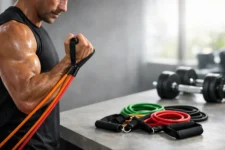
Not all bands are interchangeable. Mini loop bands are excellent for glute activation, lateral walks, and lower-body accessory work, but they are limited for full-body strength training. Long loop bands offer more versatility for squats, rows, presses, deadlifts, assisted pull-ups, and mobility work.
Tube bands with handles can feel familiar for curls, presses, and rows, especially for beginners. Their weak point is often the connection hardware, so inspect handles, clips, and attachment points regularly. Fabric hip bands tend to stay in place better than latex mini bands during lower-body work and are a strong pick for glute-focused training.
A complete setup should include several resistance levels, a stable anchor solution, and enough space to move safely. A door anchor can expand exercise options dramatically, but only when it is positioned on the hinge side of a closed door and tested carefully before each set. Never anchor a band to furniture that can slide, tip, or break.
FitwellGoods shoppers building a practical home setup can pair a multi-level band set with a workout bench, adjustable dumbbells, or a foam roller for a compact training station that covers strength, mobility, and recovery without taking over a room.
Common Mistakes That Limit Results
The most common mistake is choosing bands that are too light. The next is treating every session like a warm-up. To build muscle, the working sets need focus and effort. You should feel the target muscle working, and the last several reps should require real concentration.
Another issue is poor anchoring. If you are worried about a door opening or an anchor slipping, you cannot train with confidence. Check equipment before every session, keep bands away from sharp edges, and replace any band with cracks, fraying, thinning, or visible damage.
Finally, do not rely on only one pattern. A balanced routine includes a squat or lunge, hip hinge, push, pull, core movement, and some targeted work for areas you want to develop. Train two to four days per week, recover well, and support your goal with enough protein, sleep, and overall calories for your needs.
A Simple Full-Body Band Session
A useful starting point is band squats, Romanian deadlifts, chest presses, rows, overhead presses, and a core exercise such as Pallof presses. Complete two to three hard sets of each, resting about 45 to 90 seconds between sets. Choose resistance that challenges you in the final third of the set, not just the first few reps.
If you have more time, add curls, triceps pressdowns, lateral raises, glute bridges, or face pulls. If you have less time, alternate a lower-body exercise with an upper-body movement and keep the pace brisk. Consistency wins here. A repeatable 20-minute plan is a better investment than a complicated program you abandon after a week.
Resistance bands are effective because they make productive training available almost anywhere. Pick bands that can grow with you, train with intent, and let every hard set become proof that your setup is capable of real progress.