
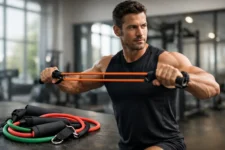
You do not need a rack full of iron to grow muscle. If you have ever looked at a loop band and wondered, do resistance bands build muscle, the short answer is yes – but only when you use them with real intent. Bands are not magic, and they are not a toy. They can absolutely help you add size, improve strength, and make your workouts more effective at home, on the road, or as part of a bigger training setup.
That matters if you want visible progress without turning your living room into a commercial gym. For busy professionals, apartment dwellers, and anyone building a smarter home setup, resistance bands give you a low-space, lower-cost way to train hard. The catch is simple: muscle growth still follows the same rules, whether the resistance comes from plates, cables, machines, or bands.
Do resistance bands build muscle or just tone?
The idea that bands only “tone” muscle is outdated. Muscle does not recognize buzzwords. Your body responds to tension, effort, training volume, and recovery. If a set of resistance band squats, presses, rows, curls, or glute bridges takes a muscle close to failure, that muscle has a reason to adapt.
That is the key point. Bands build muscle when they create enough resistance to challenge you through a set. If you finish 25 reps and barely feel anything, the band is too light or the exercise setup is too easy. If you hit 10 to 20 hard reps with control and your last few reps slow down, now you are in the zone where growth can happen.
This is why bands work surprisingly well for chest, back, shoulders, arms, glutes, and even quads when exercises are selected well. They are especially effective for higher-rep hypertrophy training, burnout sets, and adding extra volume without beating up your joints.
How muscle growth actually happens with bands
Muscle growth comes from mechanical tension, enough total work, and progressive overload. Bands can check all three boxes.
Mechanical tension means your muscles are working hard against resistance. Bands provide that resistance differently than free weights. With a dumbbell, gravity pulls down the same way throughout the rep. With a band, tension usually increases as the band stretches. That means some exercises feel easier at the start and harder at the finish.
That difference is not bad. It is just different. In presses, rows, lateral raises, and glute movements, that rising tension can create a brutal contraction at the top of the rep. It can also make bands a strong option for people who want more challenge without loading their joints with heavy weights.
Progressive overload still matters. You need to make training harder over time by using a thicker band, increasing reps, slowing tempo, shortening rest, adding sets, or improving range of motion. If you do the same easy band workout for two months, your body has no reason to grow.
Where resistance bands work best
Bands shine in more places than people expect. Upper-body accessory work is an obvious win. Band chest presses, rows, face pulls, shoulder presses, triceps extensions, and biceps curls can all produce enough tension for muscle growth, especially for beginners and intermediates.
Lower body is a little more mixed, but still strong. Glutes respond extremely well to bands because movements like kickbacks, abductions, bridges, and Romanian deadlift patterns keep tension where you want it. Quads can also grow from split squats, squats, and lunges with enough resistance and effort.
Bands are also great for adding volume after your main lifts. If you already use dumbbells or barbells, a few hard band finishers can extend a set and increase training density without needing more equipment. That is a smart play when you want more out of your setup without spending more time in the gym.
Where bands have limits
This is where the honest answer matters. Bands can build muscle, but they are not always the best tool for every goal.
For maximum lower-body strength, heavy barbells and machines usually have the edge. It is harder to load squats and deadlift-style patterns with bands in a way that matches the absolute resistance of serious free weights. Advanced lifters chasing top-end strength or size in the legs may eventually outgrow bands as a primary tool.
Bands can also be awkward at times. Setup matters. Anchor points matter. Tension curves matter. Some movements feel amazing with bands, while others feel uneven or hard to standardize. If you love precise loading, dumbbells and machines are simpler.
Still, “not always best” does not mean “not effective.” For many people, especially beginners, home exercisers, and anyone rebuilding consistency, bands are more than enough to start seeing changes.
How to make resistance bands build muscle faster
If you want results, train bands like they count. Too many people treat them like warm-up tools and then wonder why nothing changes.
First, take your working sets close to failure. You do not need sloppy reps, but you do need effort. The last few reps should feel tough. If they do not, increase resistance or make the movement harder.
Second, control the tempo. Bands can snap you back if you rush. Use that to your advantage. Lower slowly, pause where tension is highest, and finish each rep with intent. A basic band row becomes a lot more productive when you actually squeeze and control it.
Third, use enough total volume. One casual set here and there will not move the needle. Most muscle groups need multiple challenging sets per week. That can look like 3 to 5 sets per exercise and 10 to 20 hard sets per muscle group across the week, depending on your training level and recovery.
Fourth, choose exercises that match the band. Presses, rows, pulldown variations, curls, triceps work, glute bridges, split squats, pull-aparts, and lateral raises usually work better than trying to force bands into every possible movement.
Fifth, track progress. More reps, more band tension, better control, shorter rest, and cleaner range of motion all count. If your workouts are not progressing on paper, your results often stall in the mirror too.
Bands vs weights for muscle gain
If your question is whether bands can build muscle, the answer is yes. If your question is whether they are better than weights, that depends on what you need right now.
Weights usually win for straightforward loading, especially on big compound lifts. They are easier to measure and easier to scale for advanced strength goals. If you have room, budget, and access, dumbbells, barbells, and benches create more options.
Bands win on convenience, portability, joint-friendliness, and value. They are easier to store, easier to travel with, and easier to use for quick sessions when time is tight. They also pair well with home-gym basics, letting you create more exercise variety without taking over your space.
For a lot of people, the sweet spot is not bands or weights. It is bands plus weights. That setup covers heavy strength work, hypertrophy accessories, warm-ups, mobility, and finishers. More variety, more training options, and more ways to stay consistent – that is a strong return on your gear.
Who gets the best results from band training?
Beginners often see excellent progress with bands because almost any well-structured resistance training is a new growth signal. If you are just getting started, bands can help you learn movement patterns, build consistency, and train hard without feeling intimidated.
Intermediate lifters can also grow with bands, especially for upper body, glutes, and accessory volume. If your workouts are planned well and you push close to failure, bands are far from a downgrade.
Advanced lifters may find bands best used as part of a larger system rather than the whole plan. That is especially true if the goal is maximum leg size or peak strength. Even then, bands remain useful for overload, recovery-friendly volume, and travel training that keeps momentum alive.
A simple way to train for size with bands
If your goal is muscle gain, keep your weekly plan practical. Train each major muscle group at least twice a week. Build sessions around push, pull, legs, and glutes, then add direct arm and shoulder work if you want more size there.
Aim for mostly 8 to 20 reps per set, and occasionally go higher when the band is lighter. Rest long enough to perform well, usually 45 to 90 seconds for most band exercises. Focus less on fancy programming and more on hard sets done consistently.
Nutrition still matters. You need enough protein and enough total calories to support growth, especially if you want noticeable size gains. Recovery matters too. Great training with poor sleep and low protein is a slower road.
If you are building out your home setup, this is where smart gear choices pay off. A quality set of bands with multiple resistance levels gives you room to progress instead of topping out early. Pair that with a bench, some dumbbells, or recovery tools and you have a more complete system without overcomplicating your routine.
So, do resistance bands build muscle? Yes – when the resistance is challenging, the training is progressive, and the effort is real. They may not replace every piece of gym equipment for every athlete, but they can absolutely help you build a stronger, more muscular body. If bands are what you have right now, that is enough to start making progress today.










&url=https://fitwellgoods.com/shop/yoga/yoga-mat-bags/cosmos-exercise-yoga-mat-carrying-shoulder-strap-bag-with-internal-and-outside-storge-pocket-yoga-mat-is-not-included/&media=https://m.media-amazon.com/images/I/41-KtCWTK4L._SS1024_.jpg)


&url=https://fitwellgoods.com/shop/yoga/yoga-mat-straps/black-yoga-mat-straps-yoga-strap-for-carrying-mat-multi-purpose-yoga-mat-holder-sling-adjustable-straps-yoga-mat-holder-sling-for-most-size-mats-yoga-mat-not-included/&media=https://m.media-amazon.com/images/I/31D6dH-K4dL._SS1024_.jpg)

&url=https://fitwellgoods.com/shop/yoga/yoga-blocks/liliful-4-pcs-yoga-blocks-bulk-eva-foam-exercise-yoga-brick-soft-non-slip-surface-foam-blocks-high-density-yoga-blocks-to-improve-strength-balance-lightweight-yoga-brick-9x6x3blue/&media=https://m.media-amazon.com/images/I/41UxsaIe7JL._SS1024_.jpg)


