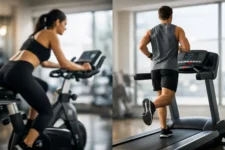
You finally cleared a corner for cardio, set a budget, and started shopping – then the big question hits: exercise bike vs treadmill. Both can help with fat loss, conditioning, and better at-home consistency, but they do not feel the same, train the same, or fit the same lifestyle. If you want visible progress without buyer’s remorse, the right pick depends less on hype and more on how you actually plan to use it.
Exercise bike vs treadmill: the real difference
A treadmill is usually the closer match to real-world movement. You walk, jog, or run, and that makes it a strong choice for people who want a familiar cardio pattern, higher impact options, and a machine that can scale from easy recovery walks to hard intervals. If your goal is to get steps in, build running fitness, or turn incline work into a calorie-burning session, a treadmill has obvious appeal.
An exercise bike changes the feel of training right away. You’re seated or partially supported, the motion is lower impact, and the learning curve is minimal. That makes it attractive for beginners, people managing knee stress, and anyone who wants to work hard without pounding their joints. It also tends to feel less intimidating for short daily sessions, which matters more than people think when motivation is inconsistent.
This is where smart shopping beats guessing. The better machine is the one you’ll use four or five times a week, not the one that sounds toughest on paper.
Calorie burn and weight loss
If you’re choosing strictly by calorie potential, treadmills often come out ahead, especially when running or using incline. Moving your full body weight against gravity generally demands more energy than pedaling in a supported position. For people chasing aggressive fat-loss goals, that can make the treadmill look like the clear winner.
But that is only half the story. A bike often lets you train longer or more often because it is easier on the joints and easier to recover from. If a treadmill workout leaves you sore enough to skip the next two sessions, the calorie math starts looking different. Consistency beats one heroic workout followed by three missed ones.
For many home-gym shoppers, the better weight-loss machine is the one that fits their routine. A 30-minute bike ride before work that happens five days a week can outperform a treadmill you avoid because your knees complain or the setup feels like a chore.
Joint impact and recovery
When the bike has the edge
The exercise bike is usually the safer bet for anyone dealing with joint sensitivity, higher body weight, or a return-to-fitness phase. Because the movement is low impact, the ankles, knees, and hips typically take less stress. That can be a major win if your goal is to build momentum without setbacks.
It is also a strong pick for active recovery. On lower-energy days, you can spin at an easy pace, get blood flow, and still feel like you checked the box. That kind of flexibility makes the bike a quiet workhorse in a home setup.
When the treadmill makes sense
The treadmill is not automatically bad for joints, but it asks more from your body. Walking at a moderate pace can still be very manageable, especially on cushioned decks, and incline walking is a favorite for people who want intensity without full-speed running. If you tolerate walking and jogging well, a treadmill can support cardiovascular progress while also helping maintain bone-loading activity that cycling does not provide in the same way.
If you already enjoy being on your feet, the treadmill may feel more natural and more useful long term.
Exercise bike vs treadmill for muscle use
A treadmill emphasizes your lower body in a weight-bearing way, with glutes, calves, hamstrings, and quads all contributing depending on speed and incline. Add hill work, and the posterior chain demand climbs fast. You also get more core involvement from staying upright and controlling your stride.
An exercise bike is still lower-body focused, but the pattern is more controlled. Quads often take a larger share of the load, though resistance settings and riding style can shift the emphasis. On an upright or spin-style bike, you can push intensity surprisingly high. On a recumbent bike, comfort becomes a bigger selling point, especially for longer sessions.
Neither machine replaces strength work, but both can support body-composition goals. If you want cardio that pairs well with leg training without wrecking you, the bike often integrates more smoothly. If you want cardio that feels closer to athletic movement, the treadmill has the advantage.
Space, noise, and home-gym fit
For apartments, shared spaces, or smaller rooms, the bike often wins. Many exercise bikes have a smaller footprint, create less floor vibration, and are easier to place in a bedroom, office, or multi-use living area. If your cardio setup needs to coexist with work calls, storage bins, and limited square footage, that matters.
Treadmills demand more room, both in footprint and clearance. Folding models can help, but they still tend to be heavier and more dominant in a room. They can also be noisier, especially during running. If you live above someone or want early-morning workouts without broadcasting every stride, the bike is usually the more neighbor-friendly option.
For busy professionals building a practical home gym, this can be the deciding factor. The best deal is not just price – it is buying something that actually fits your space and daily schedule.
Motivation and workout variety
Treadmills feel dynamic
A treadmill can feel more engaging because speed, incline, and workout style change the session quickly. You can walk while answering emails, do steep incline intervals, or train for a 5K without needing a separate plan. That versatility appeals to shoppers who want one machine to cover light movement and hard conditioning.
Bikes feel approachable
The bike has its own motivational edge: it is easy to start. There is less setup, less fear of falling behind a moving belt, and less hesitation on tired days. That lower barrier can lead to more sessions completed, which is exactly what drives results.
If you tend to procrastinate cardio, choose the machine that feels easiest to get on for 20 minutes. That one often ends up delivering the bigger return.
Cost and value
Price varies widely in both categories, but entry-level exercise bikes are often the more affordable route. They can give beginners a reliable cardio option without pushing the budget as hard as a solid treadmill. That leaves room for other upgrades like supportive training shoes, a foam roller, resistance tools, or recovery supplements.
Treadmills can offer strong value too, especially if walking and running are central to your goals. But because they usually involve larger motors, frames, and cushioning systems, the cost can climb faster when you want a model that feels stable and durable.
For shoppers who like to build a complete results-focused setup, not just buy one machine, the bike can be the smarter first move. If walking or running is non-negotiable, the treadmill may still be worth every dollar.
Who should choose which?
Choose an exercise bike if you want low-impact cardio, easier recovery, quieter training, and a smaller footprint. It is especially useful for beginners, apartment dwellers, and anyone who wants a machine that feels easy to use consistently.
Choose a treadmill if you want walking and running options, higher calorie-burn potential at top intensities, and a more weight-bearing training style. It is a strong fit for step goals, incline workouts, and people who simply enjoy being upright and moving naturally.
If your goals are mixed, think beyond the machine itself. Your best pick should match your body, your schedule, your home, and your motivation style. That is the kind of buying decision that pays off long after the first week.
The better buy for most home users
For most home users, there is no universal winner in exercise bike vs treadmill. The treadmill can be the stronger performance tool, especially for walkers, runners, and anyone chasing higher-intensity sessions. The bike is often the more practical machine – easier on joints, easier to fit at home, and easier to use often.
If you are building momentum, protecting recovery, or want cardio that does not fight your schedule, the bike often comes out ahead. If you want a more athletic, step-driven experience and you know you will use it regularly, the treadmill can absolutely be the better investment.
At FitwellGoods, that is the real goal: buy for progress, not guesswork. Pick the machine that fits your life now, and your workouts will have a much better chance of turning into a routine you keep.