That first heavy dumbbell drop tells you a lot about your setup. If the floor shakes, the noise travels, or the mat slides under your feet, your training space is costing you performance. A smart guide to home gym flooring mats starts with one simple truth – the right surface does more than protect the floor. It changes how stable, quiet, and usable your home gym feels every day.
Most people shop flooring last, somewhere after the bench, the weights, and the cardio machine. That is usually backward. Flooring affects traction, impact, cleanup, and even whether you feel confident pushing harder. If you do strength work, high-intensity intervals, yoga, or steady-state cardio, the mat under you matters more than it gets credit for.
Why this guide to home gym flooring mats matters
Home gym flooring has one job on paper and about five jobs in real life. It should protect the subfloor, reduce vibration, improve grip, absorb some impact, and make the room easier to maintain. The catch is that no single mat type dominates every category.
If you want a soft, forgiving feel for bodyweight circuits, you may give up some stability for heavy lifting. If you want a dense, nearly commercial feel for barbells and racks, you may lose comfort for floor work. That trade-off is why buying based on looks alone usually ends in regret.
The better move is to match the mat to the way you actually train. Think in terms of movement patterns, equipment weight, and room conditions instead of chasing a one-size-fits-all option.
Start with your training style
Your workouts should decide your flooring, not the other way around. A treadmill user has different needs than someone doing deadlifts in a garage, and both need something different from a person running mobility sessions in a spare bedroom.
For cardio equipment like treadmills, exercise bikes, and rowers, you want a mat that protects the floor from scuffs, sweat, and vibration. It does not need to be ultra-thick, but it should be dense enough to keep the machine stable. Too much softness under cardio equipment can create wobble, especially on wood or laminate flooring.
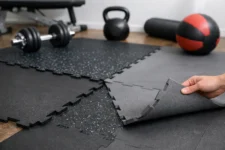
For strength training, density is the big factor. Adjustable dumbbells, kettlebells, benches, and plate storage all put pressure on the floor in concentrated spots. A flimsy foam tile might look good on day one, but it can compress fast and leave permanent dents. If you train hard and move weight often, denser rubber usually pays off.
For functional training, HIIT, agility work, and bodyweight circuits, comfort and traction move higher on the list. You need a surface that feels forgiving on joints without turning into a spongy platform. If your workouts mix burpees, lunges, planks, and jump rope, moderate cushioning with reliable grip usually hits the sweet spot.
For yoga, stretching, and recovery sessions, the priorities shift again. You may not need thick gym flooring across the whole room, but you do want a clean, comfortable surface with enough support for kneeling and floor-based work.
Material choices: what actually makes sense
Most home gym flooring mats fall into a few common categories, and each one has a clear use case.
EVA foam is light, affordable, and easy to install. It is popular for beginner setups, apartment workouts, and multipurpose rooms because it is simple to move and usually sold in interlocking tiles. The downside is durability. Foam can tear, compress, and shift under heavier equipment, so it is better for lighter training than serious lifting.
Rubber is the workhorse option. It is denser, tougher, and better at handling dropped weights, heavy foot traffic, and repeated use. It also tends to grip the floor better than foam. The trade-off is cost, weight, and sometimes smell when new. For a garage gym or dedicated strength area, though, rubber is often the smartest long-term buy.
PVC and vinyl-based mats are often used under cardio machines. They are easy to wipe down and generally thinner than full gym flooring systems. They can help with floor protection and cleanup, but they are not built for repeated impact from weights.
Carpet-top gym mats exist too, usually for equipment zones. They can look cleaner in living spaces and work well under machines, but they are not ideal where sweat, chalk, or floor exercises are part of the routine.
Thickness: more is not always better
A lot of shoppers assume thicker automatically means better. It does not. The right thickness depends on what sits on top of it and what happens on it.
Thin mats can work well under cardio equipment where stability matters most. If the machine rocks or sinks, the workout feels off and the equipment may wear unevenly over time.
Mid-range thickness is often the most versatile for mixed-use gyms. It gives you enough protection for dumbbells, bodyweight work, and general training without making the floor feel overly soft.
Thicker, denser mats make more sense when heavier weights enter the picture. If you use barbells, racks, plate-loaded equipment, or train in a garage over concrete, extra protection can be worth it. Still, thickness without density is not much of a win. A thick low-density mat may feel plush but fail when real weight hits it.
The room changes the decision
A garage gym, a spare bedroom, and an upstairs apartment should not be floored the same way.
In a garage, durability leads. Concrete is tough on equipment and tough on your body, so rubber flooring is usually the top contender. Temperature swings and moisture can matter too, especially in humid climates, so easy-clean surfaces with strong wear resistance are a plus.
In a bedroom or finished basement, noise and floor protection tend to matter more. You may be covering hardwood, laminate, or tile, so scratching and vibration become bigger concerns. In those spaces, modular mats can be practical because they are easier to fit wall to wall or under a defined workout zone.
In apartments or upstairs rooms, noise control is critical, but expectations should stay realistic. Mats can reduce some vibration and impact noise, but they will not completely silence jumping, dropping weights, or treadmill use. If you live above someone, your exercise choices matter just as much as your flooring.
How much coverage do you need?
This is where people either overspend or come up short. Full-room coverage looks sharp and gives your gym a finished feel, but it is not always necessary. If your space is small and dedicated only to training, covering the whole room can make sense.
If your setup is still evolving, start with zones. Put denser protection under the rack, bench, or dumbbell area. Use a dedicated equipment mat for cardio machines. Keep an open section for floor work. That approach is budget-friendly and easier to adjust when your training changes.
This is also where comparison shopping matters. Interlocking tiles can be easier for custom layouts, while large rolls or straight mats may create a cleaner look with fewer seams. If you like to upgrade piece by piece, modular systems usually offer more flexibility.
Common buying mistakes to avoid
The biggest mistake is buying based on price alone. Cheap mats can work for light training, but if you already own weights, a bench, or larger equipment, replacing worn flooring later often costs more than buying correctly the first time.
The second mistake is ignoring movement. People think about the equipment weight but forget the dynamic impact of stepping, pivoting, jumping, and reracking. A mat that seems fine when standing still may slide or separate once real training starts.
The third mistake is choosing the wrong surface for cleanup. If your workouts include sweat-heavy circuits, recovery work, or supplement-fueled early-morning sessions that leave shaker drips and chalk dust behind, easy maintenance matters. Textured surfaces can improve grip, but some are harder to clean than others.
A practical way to choose the right mat
If your goal is a fast, no-regret decision, narrow it down this way. For light home workouts, stretching, and bodyweight sessions, foam may be enough. For cardio machines, look for a stable protective mat designed for equipment use. For mixed training with dumbbells and circuits, aim for a denser all-purpose mat. For heavy lifting or garage setups, prioritize rubber and durability first.
If you are building your space in stages, flooring is still worth getting right early. It protects the gear you are investing in, helps the room feel more intentional, and supports better training habits. That is the kind of upgrade you notice every session, not just on day one.
At FitwellGoods, the best home gym picks are the ones that make progress easier to repeat. Flooring may not be the flashy part of the build, but it is one of the smartest. Choose the mat that fits your training now, leaves room for heavier goals later, and turns your space into a setup you actually want to use tomorrow morning.