Starting a home gym doesn’t have to be complicated or expensive. You need the right accessories to build strength, improve fitness, and stay motivated without cluttering your space or breaking your budget.
A few smart purchases can set you up for success, whether you’re working out in a spare bedroom or a corner of your living room.
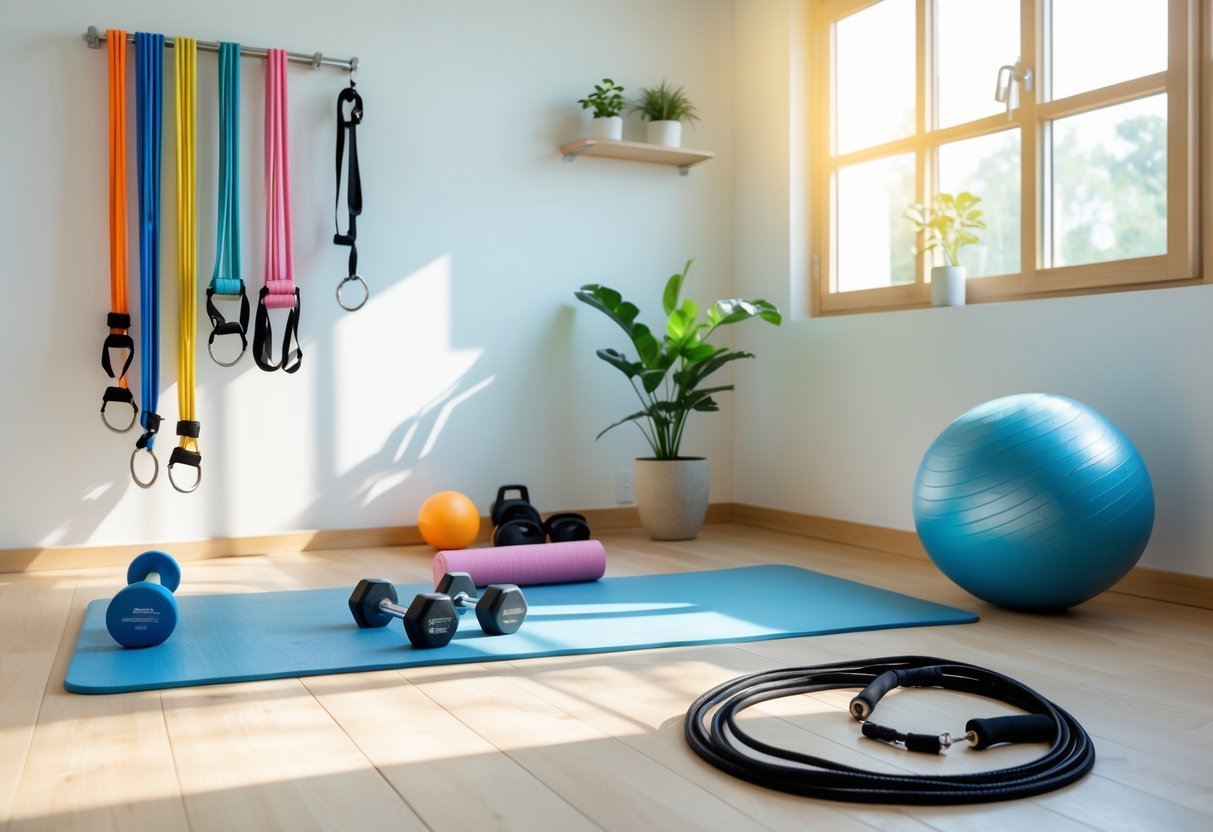
The best home gym accessories for beginners include adjustable dumbbells, resistance bands, a quality exercise mat, and a stability ball, which together provide everything you need for full-body workouts. These tools are versatile, budget-friendly, and take up minimal space.
They let you progress at your own pace while building a solid fitness foundation.
Beyond the basics, the right accessories help you stay consistent and avoid injury. From foam rollers for recovery to storage solutions that keep your space organized, each piece serves a purpose.
This guide breaks down what you actually need, what you can skip, and how to make smart choices that fit your goals and lifestyle.
Key Takeaways
- Adjustable weights and resistance bands offer the most versatility for beginners with limited space and budgets
- Recovery tools and floor protection are just as important as strength equipment for long-term success
- Focus on multi-purpose accessories first and avoid buying equipment you won’t use regularly
Why Accessories Matter in a Beginner Home Gym
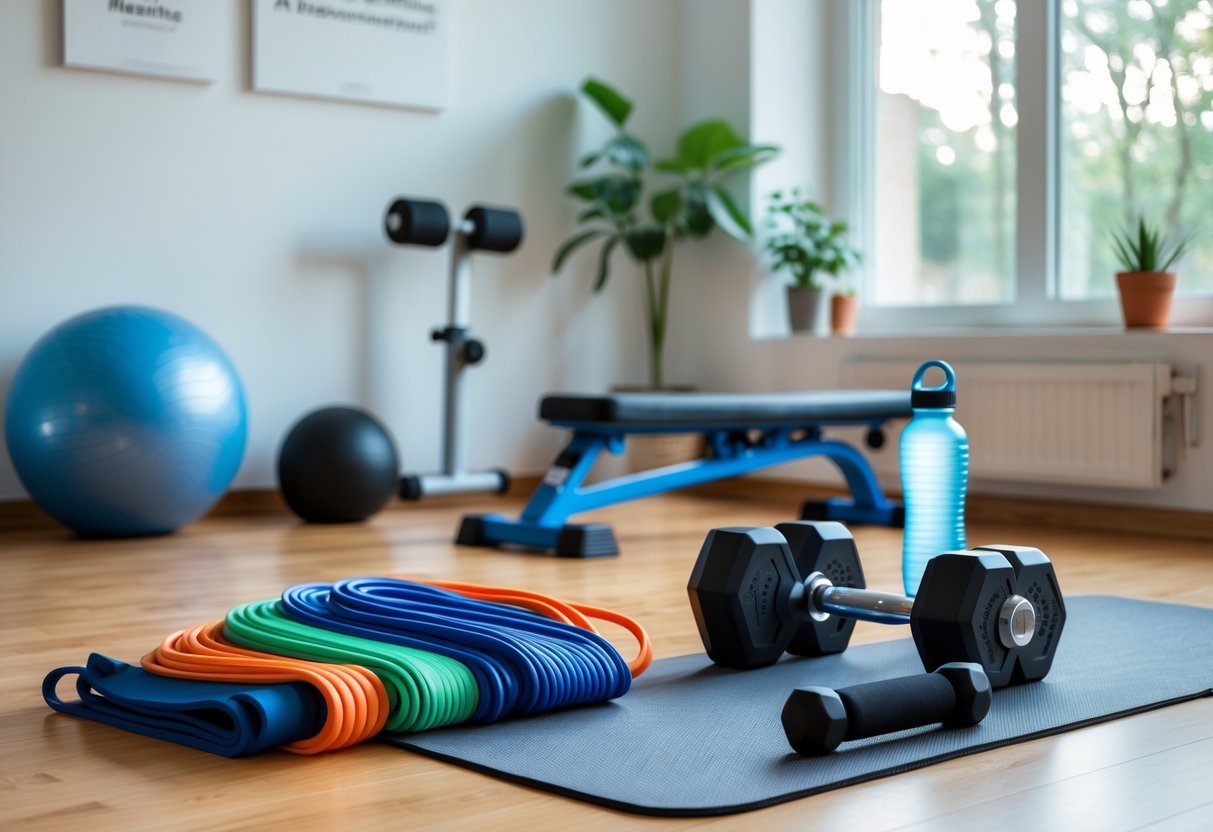
Accessories transform a basic home gym into a complete training space. They add exercise variety, protect your body, and keep you motivated.
Expanding Exercise Options
When you rely only on basic equipment like dumbbells, you limit what movements you can perform. Accessories unlock new categories of exercises that target muscles in different ways.
Resistance bands let you add tension to squats and presses while also enabling pull-aparts for shoulder health. A doorway pull-up bar opens up all back training variations.
Core sliders turn simple movements into challenging stability exercises.
These tools improve versatility without taking up floor space:
- Jump ropes for conditioning work
- Resistance bands for assisted pull-ups and stretching
- Ankle weights for leg raises and core training
- Step platforms for Bulgarian split squats and elevated movements
Each accessory expands your range of motion options and adds new training angles. This variety helps you build a balanced physique.
Comfort and Injury Prevention
Training on hard floors or gripping heavy weights without support creates unnecessary discomfort and injury risk. Simple accessories address these issues.
Floor tiles protect your joints during high-impact movements and prevent dumbbells from damaging your flooring. Wrist wraps stabilize your wrists during pressing exercises if you experience pain or weakness.
Lifting straps let your back muscles work harder during rows without your grip giving out first. Foam rollers help release muscle tension before and after workouts.
Tight muscles can limit your range of motion and increase injury risk over time. Even a basic yoga mat provides cushioning for floor exercises and prevents slipping during planks or mountain climbers.
Making Workouts Engaging
Doing the same exercises every session can become monotonous. Accessories add variety that keeps your home gym interesting.
Sliders turn basic lunges into sliding variations that challenge your balance. Bands create different resistance curves than dumbbells, providing a new stimulus for your muscles.
A jump rope provides quick cardio between strength sets without needing a treadmill.
Affordable Ways to Boost Results
Building a home gym can feel expensive, but accessories deliver impact for a relatively low cost.
Budget breakdown for essential accessories:
| Item | Price Range | Training Benefit |
|---|---|---|
| Resistance bands | $15-$30 | Full-body resistance work |
| Jump rope | $10-$25 | Cardio conditioning |
| Foam roller | $20-$30 | Recovery and mobility |
| Floor tiles (set) | $25-$40 | Joint protection |
You can equip your entire home gym with useful accessories for less than two months of commercial gym membership fees. These items last for years with proper care.
Accessories also help you get more from equipment you already own. Bands add resistance to bodyweight exercises. Straps let lighter dumbbells challenge your back harder.
This means you can delay expensive equipment upgrades while still making progress toward your goals.
Essential Strength Training Accessories
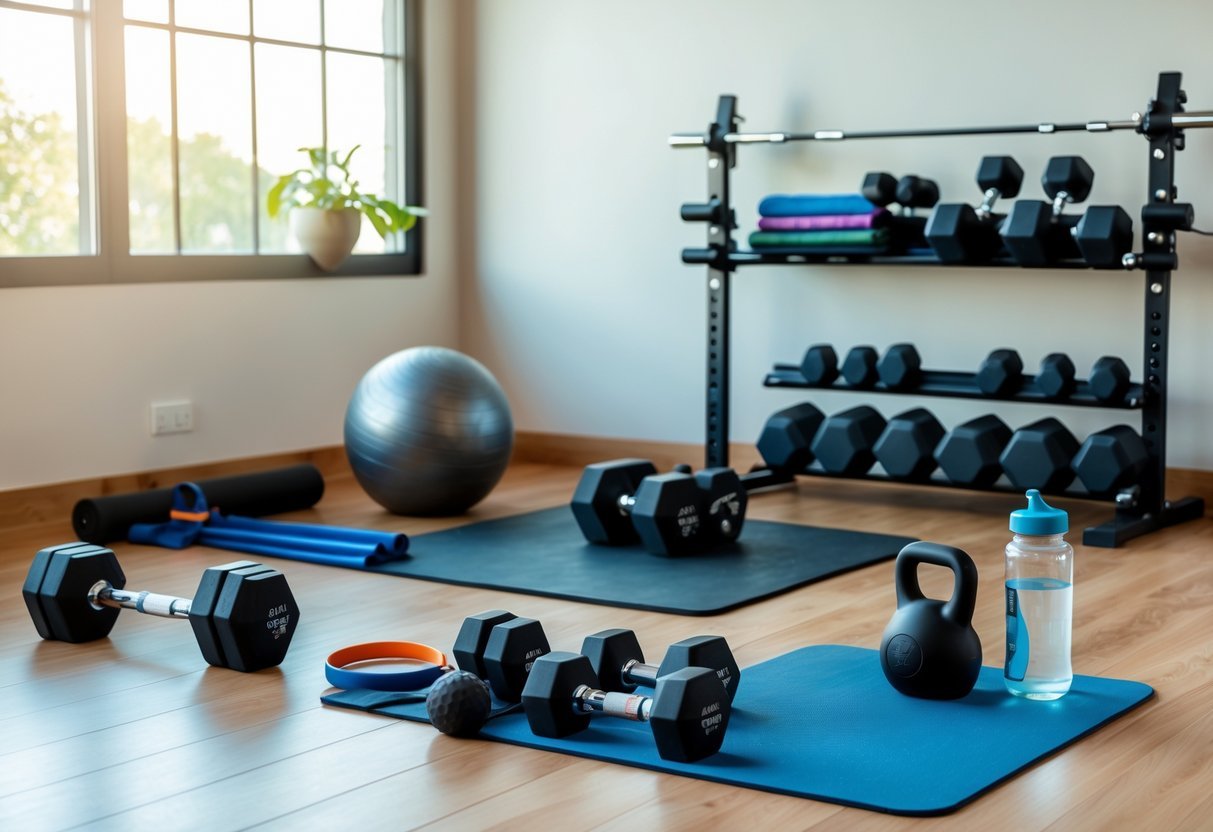
Building strength at home requires a few key pieces of equipment that support compound movements and progressive overload. Dumbbells, barbells, weight benches, and kettlebells form the foundation of most beginner strength programs.
Dumbbells and Adjustable Dumbbell Sets
Dumbbells are versatile tools that let you work each side of your body independently. You can use them for dozens of exercises including rows, presses, curls, and lunges.
Adjustable dumbbells save space and money compared to buying multiple pairs of fixed-weight dumbbells. They let you change resistance quickly by adding or removing weight plates or turning a dial.
Most adjustable sets range from 5 to 50 pounds per dumbbell. Fixed dumbbells work well if you have storage space and a budget for several pairs.
Start with lighter weights to learn proper form. As you get stronger, add heavier options to your collection.
Both types support progressive training, which means gradually increasing weight over time.
Barbells, Weight Plates, and Bumper Plates
A barbell opens up compound lifts like the squat, deadlift, bench press, and overhead press. These movements work multiple muscle groups at once.
Olympic barbells are standard size at 7 feet long and weigh 45 pounds. They have rotating sleeves that reduce wrist strain during lifts.
The best barbell for beginners has good knurling (grip texture) without being too rough. Weight plates attach to the barbell ends.
Standard plates come in pairs from 2.5 to 45 pounds. Cast iron plates cost less but can damage floors if dropped.
Bumper plates have rubber coating that protects your floor and reduces noise. Options like Fringe Sport Black Bumper Plates are durable and beginner-friendly.
They’re essential if you plan to do Olympic lifts or drop weights safely. Start with a basic set: one barbell, two 45-pound plates, two 25-pound plates, two 10-pound plates, and smaller pairs for fine adjustments.
Adjustable Weight Benches
An adjustable bench supports proper form for upper body exercises. You can set it flat for bench press or angled for incline and decline variations.
The flat position works your mid-chest during presses. The incline setting targets upper chest and front shoulders.
The decline angle emphasizes lower chest muscles. Beyond pressing movements, you can use your bench for rows, step-ups, Bulgarian split squats, and seated shoulder presses.
It adds stability that improves your technique. Look for a bench that locks securely at different angles.
It should feel sturdy under your body weight plus any dumbbells or barbell you’re lifting. A foldable design helps save space when you’re done training.
Kettlebells and Adjustable Kettlebells
Kettlebells build strength, power, and endurance through dynamic movements. The offset weight distribution challenges your grip and core differently than dumbbells.
Common kettlebell exercises include swings, goblet squats, Turkish get-ups, and single-arm presses. These movements improve coordination and build muscle.
For beginners, start with a light to medium weight. Men typically begin with 35 pounds and women with 18 pounds.
You can always add heavier kettlebells as your strength improves. Adjustable kettlebells let you change weight using removable plates or a pin system.
They’re practical if you want multiple weight options without buying several kettlebells. One adjustable unit can replace three or four fixed-weight bells.
Core Resistance and Bodyweight Accessories
Resistance bands, pull-up bars, and gymnastic rings form the foundation of effective bodyweight training at home. These tools help you build grip strength and perform exercises like rows and pull-ups without expensive machines.
Resistance Bands and Loop Sets
Resistance bands offer an affordable way to add tension to your workouts without weights. You can choose between loop bands that circle around your legs or longer bands with handles for upper body work.
Loop bands work great for glute exercises like side steps and clam shells. They typically come in sets of five with different resistance levels marked by color.
Pull-up bands are longer and thicker than loop bands. You can wrap them around a pull-up bar to assist with pull-ups and dips.
These same bands work for rows when you attach them to a sturdy anchor point. Most sets cost between $10 and $30 for beginners.
Common Resistance Band Uses:
- Glute bridges and hip thrusts
- Assisted pull-ups and dips
- Banded rows
- Shoulder exercises
- Warm-up movements
Pull-Up Bars and Doorway Solutions
A doorway pull-up bar lets you perform pull-ups, chin-ups, and hanging exercises at home. Most models wedge into your door frame without screws or permanent installation.
You need to make sure your door frame can support your body weight plus some extra force from the movement. These bars typically hold between 200 and 300 pounds.
Some designs include foam grips to protect your hands and multiple grip positions for different exercises. You can also hang resistance bands from the bar for assisted pull-ups.
Basic doorway bars cost $25 to $50.
Gymnastic Rings for Versatility
Gymnastic rings attach to your pull-up bar or ceiling mount with adjustable straps. They let you perform rows, dips, push-ups, and pull-ups with unstable handles that challenge your grip strength and core stability.
The instability makes basic exercises harder and builds more muscle control. Rings come in wood or plastic materials.
Wood rings provide better grip when your hands sweat. Plastic rings cost less and clean easier.
Both types work well for beginners. You can adjust the height for different exercises.
Set them low for rows and high for pull-ups. Most ring sets cost between $30 and $60.
Cardio Equipment for Home Beginners
Cardio equipment helps you build endurance and burn calories without leaving your house. Jump ropes offer a budget option while exercise bikes, treadmills, and rowing machines provide low-impact workouts that fit different fitness levels.
Jump Rope and Skipping Ropes
A jump rope is one of the most affordable cardio tools available. Basic models are typically under $10, while weighted versions range from $15 to $30.
Jump ropes work well in small spaces, requiring about 6 feet of clearance in each direction. This makes them suitable for apartments or limited room environments.
Jumping rope burns approximately 10 to 16 calories per minute, depending on intensity. You can increase difficulty by varying speed or performing moves such as double-unders and crossovers.
Start with short sessions of 5 to 10 minutes to allow your calves and coordination to adapt. Select a rope with adjustable length to match your height.
Exercise Bikes and Indoor Cycling
Exercise bikes provide smooth, low-impact cardio that is gentle on the joints. They are a good option for individuals with knee or hip concerns.
Most indoor cycling bikes use magnetic resistance with 20 to 24 levels, allowing for a range of intensity from light pedaling to hill climbs. Some advanced models, such as the NordicTrack S22i, include incline and decline features to mimic outdoor terrain.
Smart bikes can connect to apps offering guided classes and scenic rides. Memberships for these services typically cost $30 to $40 per month.
Key features to look for:
- Adjustable seat and handlebars
- Dual-sided pedals (clips and toe cages)
- Quiet operation
- Weight capacity of 300+ pounds
Exercise bikes generally require about 4 feet by 2 feet of floor space. They can be used while watching TV or listening to music.
Treadmills and Running Machines
Treadmills allow for walking, jogging, or running regardless of weather conditions. Speed and incline are adjustable to suit different fitness levels.
Basic treadmills start around $500, with quality models ranging from $1,000 to $2,000. They require more space than most cardio equipment, typically about 6 feet by 3 feet.
Most treadmills offer speeds from 0.5 to 12 mph. Beginners are advised to start walking at 2 to 3 mph.
Incline features can add intensity without increasing speed. Shock absorption systems help reduce impact on joints.
A sturdy frame and a motor rated for continuous use are important for regular running. The weight capacity should exceed your body weight by at least 50 pounds for safety and durability.
Folding models can save space but may offer less stability during use.
Rowing Machines and Rowers
Rowing machines provide full-body cardio, engaging approximately 85% of muscles per stroke. Each movement works the legs, core, back, and arms.
Rowers burn calories at a rate similar to running but with less joint impact. Intensity is adjustable by changing stroke rate and resistance level.
Types of resistance:
- Magnetic: Quiet and smooth, suitable for apartments
- Air: Resistance increases with rowing effort
- Water: Simulates the feel of real rowing
Most rowing machines require about 8 feet by 2 feet of space during use. Many models fold vertically for compact storage.
Proper form is crucial; legs should drive each stroke, not the arms. Maintain a straight back and engaged core throughout.
Entry-level rowers typically cost $300 to $500. Higher-end models with enhanced build quality are priced between $800 and $1,500.
Mobility, Recovery, and Floor Protection
Recovery tools and protective flooring help prevent injury and protect your home gym space. These accessories support the body between workouts and contribute to the longevity of your equipment and flooring.
Foam Rollers for Muscle Recovery
Foam rollers help release muscle tension and may improve blood flow after training. Rolling tight areas for 30-60 seconds can reduce soreness and stiffness in the legs, back, and shoulders.
Standard foam rollers cost $20-$30 and are suitable for most beginners. Medium-density rollers provide a balance between comfort and effectiveness.
Very soft rollers may not apply sufficient pressure, while very hard rollers can be uncomfortable for beginners.
Best areas to roll:
- Quads and hamstrings
- Upper and lower back
- IT band (outer thigh)
- Calves
Roll slowly and pause on tender spots. Avoid rolling directly over joints or bones.
Use foam rollers 3-5 times per week, especially on rest days.
Yoga Mats and Stretching Pads
A yoga mat provides cushioning for floor exercises and stretching. Standard mats are 68-72 inches long and 4-6mm thick, offering protection for knees and spine during various exercises.
Thicker mats (8-10mm) offer additional joint protection for movements such as leg raises and mountain climbers. These typically cost $25-$40 and are beneficial for those with sensitive knees or elbows.
The mat should have good grip on both sides to prevent sliding. Textured surfaces are preferable, especially during sweaty workouts.
Clean mats weekly with mild soap and water to maintain grip and hygiene.
Protective Exercise Flooring
Floor tiles or rubber mats protect flooring from weights and equipment. Interlocking foam tiles cost $25-$40 for a 24-square-foot set and are suitable for most beginner setups.
Rubber flooring provides enhanced durability and shock absorption. It also helps reduce noise from dropped weights and protects equipment.
Standard tiles are ½ to ¾ inch thick. Thicker tiles offer better noise reduction but are more expensive.
Measure your workout area before purchasing to ensure adequate coverage.
All-in-One Machines and Functional Trainers
All-in-one machines consolidate multiple training stations into a single footprint. Functional trainers use cable pulley systems to facilitate a wide range of exercises.
These machines are practical for building a comprehensive home gym without purchasing separate equipment for each muscle group.
Smith Machines for Guided Lifting
A Smith machine features a barbell fixed on vertical rails, guiding the lifting path. This assists with learning proper form on exercises such as squats, bench presses, and overhead presses.
The guided path can reduce injury risk during the initial stages of strength training. Most Smith machines include safety arms to catch the bar if a repetition cannot be completed.
Safety stops can be adjusted to accommodate different heights and ranges of motion. Smith machines are space-efficient compared to a power rack with a separate barbell setup.
Some models combine a Smith machine with a power rack, offering both guided and free-weight options. The fixed bar path, however, does not engage stabilizer muscles as effectively as free weights.
Functional Trainers and Cable Pulley Systems
Functional trainers utilize two independent cable pulley systems with adjustable height settings. Each cable typically provides 150 to 220 pounds of resistance via weight stack or plate-loaded mechanisms.
Adjustable cable pulleys allow for exercises at various angles, including chest flies, rows, tricep extensions, bicep curls, and core rotations. Cables maintain constant tension throughout each movement.
Most systems use a 2:1 pulley ratio, so a 200-pound stack offers 100 pounds of working resistance per side. This setup enables smooth, controlled movements suitable for beginners.
Cable systems offer greater versatility than traditional machines by allowing movement in multiple planes. This can help develop functional strength for daily activities.
Multi-Station and All-In-One Home Gyms
An all-in-one home gym typically combines a power rack, functional trainer, and sometimes a Smith machine into a single unit. These machines support 25 to 100+ exercises, depending on the model and included attachments.
Popular setups, such as the Force USA G3 and G6, fit multiple training stations into a footprint of approximately 80 inches by 55 inches. These systems often include chin-up bars, dip stations, and attachment points for bands and suspension trainers.
Common features in all-in-one machines:
- Weight stacks (210 to 440 pounds total)
- Multiple cable stations
- Built-in benches or bench attachments
- J-hooks and safety spotter arms
- Landmine attachments
Budget options, like the Bowflex PR1000, use power rods instead of weight plates and offer up to 210 pounds of resistance. These are cost-effective for beginners but may lack the adjustability of plate-loaded or pin-select systems.
All-in-one machines require a significant upfront investment and typically take 2 to 4 hours to assemble. They offer less expandability compared to modular power racks.
Accessory Selection for Small Spaces and Budgets
Small living spaces and limited budgets can still accommodate an effective home gym. Selecting accessories that fold, stack, or store easily while serving multiple functions is key.
Compact Essentials for Apartments
Resistance bands are compact and cost $15-$30 for a complete set. They can be stored in a drawer and used for warmups, strength, and mobility exercises.
Jump ropes, priced at $10-$25, are easy to store and provide effective cardio workouts.
Core sliders, costing $10-$15, can be kept under furniture and enable a variety of bodyweight exercises for the core, legs, and upper body.
Foam rollers can be stored vertically in closets and generally cost $20-$30. A standard 36-inch roller is versatile for back and leg use.
A doorway pull-up bar installs without permanent fixtures and typically costs $25-$40. These support pull-ups, chin-ups, and hanging core exercises.
Budget Home Gym Starter Kits
An initial budget of $100 can cover resistance bands, a jump rope, and core sliders, allowing for comprehensive strength and cardio training.
Starter Kit #1 (Under $75)
- Loop resistance band set: $20
- Long pull-up bands: $25
- Jump rope: $15
- Core sliders: $10
Starter Kit #2 (Under $100)
- Adjustable dumbbells (light set): $40
- Resistance bands: $20
- Yoga mat: $20
- Wrist wraps: $15
An adjustable kettlebell, costing $40-$60, replaces several fixed-weight kettlebells and allows for varied resistance in different exercises.
Prioritizing Versatility and Value
Choose accessories that serve multiple purposes. Resistance bands can assist with pull-ups, add resistance to squats, and improve shoulder mobility.
Single-purpose gadgets, such as complex ab wheels or twist boards, are often underutilized.
High-Value Accessories
- Resistance bands: Suitable for 20+ exercises
- Jump rope: Useful for cardio and warmups
- Sliders: Effective for core and leg training
- Foam roller: Supports recovery and mobility
Adjustable dumbbells conserve space compared to fixed weights. A single pair can replace several individual dumbbell sets.
Start with a few versatile accessories and expand as budget allows. Prioritize quality over quantity when selecting equipment.
Organizing and Personalizing Your Home Gym
A well-organized home gym enhances safety, efficiency, and enjoyment during workouts. Proper storage and equipment placement contribute to a functional and motivating environment.
Arranging Equipment for Accessibility
Store frequently used items, such as dumbbells, resistance bands, and jump ropes, within easy reach of the main workout area. Place larger equipment and cardio machines along walls to maximize open floor space.
Maintain at least three feet of clearance around equipment to ensure safe movement and minimize injury risk.
Group similar items together, such as stacking weight plates by size and arranging dumbbells from lightest to heaviest. Keep all bands in a single location.
Position equipment requiring power near electrical outlets to avoid running extension cords across the workout space.
Storage Solutions and Safety
Wall-mounted racks hold barbells, weight plates, and resistance bands off the floor. Steel storage racks fit in corners and keep dumbbells organized by weight.
Use these storage options:
Pegboard systems with hooks for small accessories
Hanging shoe organizers for gloves and wraps
Baskets or bins for foam rollers and towels
Wall hooks for yoga mats and jump ropes
Label your storage containers and shelves. This keeps everything in its place and makes cleanup faster after workouts.
Clean your equipment regularly. Wipe down weights and mats to maintain them in good condition.
Store items properly to prevent rust and damage. Keep your floor clear of loose equipment.
Store everything immediately after use to avoid tripping hazards.
Creating a Motivating Training Environment
Add a full-length mirror to check your form during exercises. Mirrors can make small spaces feel larger and help you focus on proper technique.
Install good lighting. Bright lights help maintain alertness during workouts.
Natural light from windows works well if available. Choose paint colors that energize you.
Blues and greens create calm feelings. Reds and oranges can boost energy levels.
Hang a corkboard for workout schedules and progress photos. Track your goals where you can see them daily.
Add personal touches like motivational quotes or a speaker for music. Your gym should feel like a space you want to use every day.
Smart Tools, Tech, and Apps for Beginners
Technology can simplify tracking progress and guiding workouts. These tools support motivation and help you learn proper form.
Workout Tracking and Progress Apps
Workout tracking apps let you record exercises, sets, and reps to monitor improvement. Many apps also track your weight, body measurements, and workout frequency for a comprehensive overview.
Most tracking apps are free or cost less than $15 per month. They work on your phone or smartwatch and can send reminders for scheduled workouts.
Some options offer automatic rep counting and pre-built workout plans. The best apps for beginners have simple interfaces and quick logging features.
Look for apps that show progress with clear charts. Many apps connect with fitness wearables to track heart rate and calories burned during sessions.
Virtual Coaching and Guided Sessions
Virtual coaching apps provide video demonstrations and real-time instruction for home workouts. Services like iFIT and Caliber offer on-demand classes led by certified trainers.
These platforms typically cost between $30 and $40 per month. Some pair with smart equipment, such as bikes that automatically adjust resistance based on instructor cues.
Certain apps use your phone’s camera to check form and provide feedback. Beginner-focused programs start with basic movements and gradually increase in difficulty.
Many services let you choose workout length, equipment, and fitness level. This flexibility helps you build a consistent routine that fits your schedule and abilities.
Maintenance, Safety, and Longevity Tips
Proper care extends the life of home gym accessories and helps prevent injuries. Understanding weight limits and performing regular checks will keep equipment functioning safely.
Weight Capacity and Equipment Care
Each piece of gym equipment has a specific weight capacity. Benches typically support 300 to 1,000 pounds, while most pull-up bars handle 200 to 350 pounds.
Check manufacturer specifications before use and do not exceed these limits. Clean your equipment after each workout with a soft cloth and gentle disinfectant.
Sweat can cause rust and degrade materials over time. Pay special attention to handles, grips, and bench surfaces.
Inspect cables, pulleys, and bolts weekly for signs of wear. Tighten loose connections promptly.
Apply silicone-based lubricant to moving parts monthly. Replace frayed cables or worn straps immediately.
Store accessories in a dry area with stable temperatures. Avoid exposing equipment to extreme heat, cold, or humidity.
Routine Safety Checks
Set safety arms on power racks and squat stands at the correct height before each use. Position them just below your lowest lifting point.
Test the positioning with an empty bar before loading weight. Look for these warning signs before every workout:
Cracks or bends in metal frames
Loose or missing bolts and screws
Worn padding or torn upholstery
Unstable bases or wobbly connections
Damaged resistance bands or frayed straps
Ensure collars are secure on barbells and dumbbells. Plates can slide off during exercises without proper fasteners.
Keep your workout area clear of obstacles that could cause trips or falls. Replace any damaged equipment rather than attempting repairs.
Maximizing Range of Motion and Adjustability
Most beginner accessories include adjustable features to accommodate different exercises and body sizes.
Learn how to properly adjust benches, cable attachments, and safety equipment before your first workout. Adjustable benches should lock firmly at each angle setting.
Test the lock mechanism before adding weight. Set the bench to flat, incline, and decline positions to understand adjustment functions.
Cable machines require proper pulley height adjustment for different exercises. High positions suit lat pulldowns, while low settings are used for rows and curls.
Always secure pins completely in adjustment holes. Adjust seat heights, pad positions, and handle distances to match your build.
Proper positioning prevents strain and helps maintain correct form. Take time to find the right settings for your body.
Mistakes to Avoid With Accessories
When building a home gym, it is important to choose equipment wisely and use it correctly. Prioritizing quality and function supports long-term fitness progress.
Avoiding Gimmicks and Unnecessary Purchases
Many beginners purchase accessories based on marketing claims rather than practical utility. Products advertised as “revolutionary” or “effortless” often see little use over time.
Stick to proven basics like resistance bands, dumbbells, and yoga mats. These tools are versatile and effective for a wide range of exercises.
Before buying any accessory, consider if it serves a clear purpose in your workout routine. Be cautious about single-use gadgets that target only one muscle group.
A basic kettlebell is more versatile than a specialized ab roller. Investing in multi-functional equipment maximizes your budget.
Red flags for gimmicky products:
Promises of “instant results” or “no effort required”
Only targets one small muscle group
No clear explanation of how it works
Mostly positive reviews that sound scripted
Requires expensive add-ons or subscriptions
Focusing on Proper Form and Education
Owning appropriate accessories is only effective if used safely and correctly. Poor form can lead to injuries and hinder progress.
Take time to learn proper technique before increasing weight or resistance. Watch instructional videos from certified trainers or consider sessions with a professional.
Start with lighter resistance bands or dumbbells to practice form. Your muscles need time to adapt to new movement patterns.
Once you can perform 10-12 reps with good form, you can increase resistance. Use a mirror or record yourself to monitor technique.
Correcting form early helps prevent future issues. Small adjustments can make a significant difference in safety and effectiveness.
Balancing Quantity With Quality
A large collection of inexpensive accessories tends to wear out quickly and may not perform well. Investing in durable materials ensures better long-term value.
A quality resistance band is less likely to break during use. Well-made dumbbells maintain their grip and finish.
Check weight limits on benches and stability balls to ensure they support your body safely. Three to five quality items are sufficient for most beginner routines.
A set of adjustable dumbbells, one exercise mat, and a few resistance bands cover most needs. Read reviews from users who have owned the product for several months.
Look for feedback about durability, comfort, and performance. Pay attention to any reports of material wear or safety concerns.
Frequently Asked Questions
Selecting home gym equipment depends on available space, budget, and fitness goals. The right accessories can support full-body workouts without overcrowding your space.
What essential equipment should I consider for starting a home gym?
Dumbbells, resistance bands, a yoga mat, and a stability ball are foundational items. These support strength, flexibility, and balance exercises.
Adjustable dumbbells save space and offer multiple weight options. A quality yoga mat protects floors and provides cushioning.
Resistance bands offer variable resistance for numerous exercises. A stability ball adds core training and can serve as a workout bench for certain movements.
What are some affordable options for workout equipment at home?
Resistance bands, typically priced between $10 and $30, provide a wide range of exercise options. A basic yoga mat costs $15 to $40 and offers support for floor exercises.
Jump ropes, at $10 to $25, are effective for cardio in small spaces. Adjustable dumbbells range from $50 to $300, replacing the need for multiple pairs.
What beginner-friendly exercise devices are best for small spaces?
Resistance bands require minimal storage and can be used with doors or furniture. A foldable exercise mat stores easily under a bed or in a closet.
Adjustable dumbbells combine several weight options into a compact set. A suspension trainer like TRX attaches to a door and fits in a small bag.
What is a good set of beginner workout equipment?
A starter set should include adjustable dumbbells (5 to 25 pounds), resistance bands with multiple levels, and a quality exercise mat. A stability ball is a useful addition if budget allows.
This combination enables a variety of upper body, lower body, and core exercises. The total cost ranges from $100 to $400, depending on quality.
Which home gym accessories can help me achieve a full-body workout as a newbie?
Dumbbells support major muscle group exercises such as squats, presses, rows, and curls. Resistance bands provide variety and target stabilizer muscles.
A pull-up bar allows for upper body movements not possible with dumbbells. An exercise mat supports floor-based exercises and stretching.
A foam roller assists with recovery and flexibility. These accessories cover strength, cardio, flexibility, and recovery needs for a complete workout.
How can I build a cost-effective and space-efficient gym at home?
Focus on adjustable and multipurpose equipment that serves multiple functions. Adjustable dumbbells can replace entire weight sets.
Resistance bands offer a variety of exercise options in one compact package. Choose equipment that stores easily when not in use.
Resistance bands, yoga mats, and jump ropes can fit in small spaces or hang on walls. Start with three core items: adjustable dumbbells, resistance bands, and a mat.
This basic setup typically costs $100 to $200 and fits in a closet. Add equipment gradually as your needs and budget allow.



![Tumaz Yoga Strap/Stretch Bands [15+ Colors, 6/8/10 Feet Options] with Extra Safe Adjustable D-Ring Buckle, Durable and Comfy Delicate Texture – Best for Daily Stretching, Physical Therapy, Fitness](https://m.media-amazon.com/images/I/51BduAOgo0S._SS300_.jpg)





&url=https://fitwellgoods.com/shop/yoga/yoga-mat-bags/gym-bag-with-yoga-mat-holder%ef%bc%8cyoga-mat-bags-fits-all-your-daily-stuff-for-womenno-yoga-mat/&media=https://m.media-amazon.com/images/I/41Ej7u-wlqL._SS1024_.jpg)


&url=https://fitwellgoods.com/shop/speed-agility/sports-agility-ladders/trademark-innovations-agility-quad-ladder-12-adjustable-rungs-on-four-training-ladders-red-and-yellow/&media=https://m.media-amazon.com/images/I/41edwYACXAL._SS1024_.jpg)


