
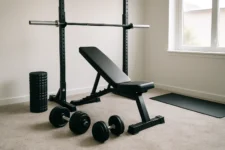
Your first home gym mistake is buying the “fun” thing first.
The treadmill looks heroic. The big bench feels legit. The premium dumbbells scream commitment. Then reality hits: you’re missing the small stuff that makes workouts frictionless – and your budget is gone.
A home gym setup under 500 can feel surprisingly complete if you build it like a training plan, not a shopping spree. The goal is simple: cover the main movement patterns, keep progress measurable, and leave room for recovery so you can train again tomorrow.
What a real home gym setup under 500 should do
If you can push, pull, hinge, squat, and carry at home, you can build muscle, drop body fat, and stay consistent without “needing” a commercial gym. That’s the core. Everything else is optional based on your goals and space.
The trade-off with a sub-$500 build is that you won’t get every possible exercise variation on day one. You’re choosing adaptable tools over specialty machines. That’s not a compromise – it’s how you avoid clutter and keep the workouts happening.
Here’s the mental model: buy equipment that grows with you. Adjustable resistance, modular loading, and simple setups beat single-use gear every time.
Start with your space and one training goal
Before you add items to your cart, answer two questions.
First: where will you actually work out? A spare bedroom, garage corner, apartment living room, or patio all change what “smart” looks like. If you’re in an apartment, noise and floor protection matter. If you’re in a garage, rust resistance and storage matter. If you have zero storage, anything that folds, stacks, or fits under a bed wins.
Second: what’s your primary goal for the next 8-12 weeks? Fat loss, strength, muscle gain, or “general fitness” are not the same shopping list. You can still train everything – but your budget should prioritize what will keep you consistent.
A simple example: if fat loss is the priority, you’ll benefit from a basic conditioning tool plus strength essentials. If muscle gain is the priority, you’ll put more money into loadable resistance and a stable surface.
Budget split that keeps you under $500
Most people overspend on one category and underfund the pieces that make training easier. A clean split is:
Spend about 60-70% on strength, 15-25% on conditioning, and 10-15% on recovery and “don’t-skip” accessories. If your space is hard floors or upstairs neighbors live below you, carve out a little for flooring early – it’s not glamorous, but it’s what keeps you training.
The best part is you can move money between categories based on your goal. The key is not skipping strength altogether. Even if you love cardio, strength work is what protects muscle while you cut and keeps your metabolism and joints happier long-term.
The strength core: one smart resistance choice
If your budget is tight, your strength setup should revolve around one of these approaches.
Option A: Adjustable dumbbells (fastest, simplest)
Adjustable dumbbells are the cleanest way to cover full-body strength with minimal footprint. You can press, row, squat, hinge, lunge, and carry. They also make progressive overload straightforward: add weight, add reps, add sets.
The trade-off: very heavy lower-body training can outgrow many dumbbell sets, and some designs can feel bulky for certain movements. But for most beginners and intermediate lifters, adjustables are the best “one purchase” that prevents decision fatigue.
Option B: Kettlebell plus bands (best for conditioning and athletic feel)
A single kettlebell paired with resistance bands is a sleeper build. Swings, goblet squats, presses, rows, and carries get you strong – and the kettlebell delivers conditioning without needing a machine.
The trade-off: progressing load is less linear unless you buy multiple kettlebells over time. Bands help, but they feel different than iron. If you thrive on structure and numbers, dumbbells may keep you more consistent.
Option C: Loadable handles with plates (best value per pound)
If you want heavier training on a budget, loadable dumbbell handles plus plates can be the best dollars-to-weight ratio. It’s not as slick as adjustables, but it scales.
The trade-off: changing weights takes longer, and plates take space. If you know you’ll stick with training and you have storage, this option can be a long-term win.
A bench is optional – until it isn’t
A bench is not mandatory to start, but it becomes a major upgrade once you’re training consistently. If you’re pressing on the floor and doing rows supported on a chair, you can still get results. But a stable bench improves comfort, range of motion, and exercise variety.
If you add a bench under $500 total, prioritize stability and a footprint that fits your space. Adjustable benches give more options, but a simple flat bench can be enough if your focus is basic strength.
Here’s the “it depends” moment: if you have shoulder history or want more chest and upper-back work, a bench is worth earlier budget. If you’re focused on fat loss and minimal gear, delay the bench and put that money into resistance and conditioning.
Conditioning without blowing the budget
Cardio equipment gets expensive fast, so the move is choosing tools that deliver a training effect without eating your entire $500.
A jump rope is cheap and brutally effective if your joints tolerate it and your space allows it. If you’re in an apartment or you hate impact, a compact step platform or even a simple walk program can carry your conditioning while you invest in strength.
If you want one conditioning tool that also builds power and grip, a kettlebell does double duty. If you want a low-skill, low-space option, a set of loop bands can create quick circuits that spike heart rate without noise.
The accessories that make consistency automatic
This is the part people skip – and then wonder why they stop training.
A quality exercise mat gives you a clean place for core work, mobility, and warm-ups. Basic flooring protection (even a couple of durable tiles or a thicker mat) reduces slipping and noise. A foam roller or massage ball can keep your hips, back, and calves from feeling like concrete after week one.
If you track workouts, the most underrated “equipment” is a simple way to measure progress. That could be a notebook, an app, or a notes doc – but you need something. The home gym that works is the one that makes progress visible.
Three example builds (pick the one that matches your goal)
To keep this practical, here are three realistic paths that stay within a home gym setup under 500. Prices vary by sales and season, so treat these as budget targets, not fixed numbers.
Build 1: Strength-first (muscle and tone)
Put most of the budget into adjustable dumbbells or loadable handles and plates. Add a mat and a basic band set for warm-ups, pull-aparts, and finishing sets. If there’s room, add a flat bench as your “phase two” upgrade when you know you’re consistent.
This build shines for people who want visible body composition change. Pair it with a simple program: 3 full-body sessions per week, add reps until you hit the top of a range, then add weight.
Build 2: Fat-loss and conditioning (busy schedule friendly)
Choose one versatile strength tool (a kettlebell or adjustable dumbbells), then add a jump rope or band-based conditioning plan. Keep recovery in the budget: a foam roller and mat are what allow you to train frequently without feeling wrecked.
This build works when time is tight. You can do 20-30 minute sessions: strength + short conditioning finisher. The win is repeatability.
Build 3: Small-space apartment (quiet, minimal storage)
Go bands plus adjustable dumbbells if possible, or bands plus a single kettlebell if you want one heavy object. Add a thicker mat for floor comfort and noise control. Skip bulky benches and anything that rattles.
The trade-off is you’ll need more creativity for pulling movements. Bands handle rows well, and one-arm dumbbell rows on a chair work fine. Consistency beats perfect exercise selection.
If you want a one-stop place to compare options across strength, conditioning, and recovery categories while you hunt for deals, you can browse FitwellGoods and build a cart that matches your budget and goal without bouncing between stores.
Don’t forget the “comfort gear” that keeps you training
This isn’t vanity. If your shoes slip, your hands tear up, or your clothes ride up, you will train less.
If you’re doing dynamic work like jump rope, lunges, or kettlebell swings, cross-training shoes can make sessions feel more stable. For strength days, grippy socks or flat, stable shoes help too. And if you sweat a lot at home, a couple of workout-ready tees or shorts you actually like wearing will remove a surprising amount of friction.
The simplest weekly plan to use your new setup
You don’t need a complicated routine to justify your gear. You need one you’ll repeat.
Train three days per week with full-body strength: a squat pattern (goblet squat or split squat), a hinge (Romanian deadlift or swings), a push (floor press or overhead press), a pull (rows or band rows), and a carry or core finisher.
On two other days, do 15-25 minutes of conditioning: rope intervals, kettlebell swings, band circuits, or brisk incline walking if you have access. Keep one day for mobility and recovery work. If you’re sore, that’s not a reason to stop – it’s a reason to do lighter movement and come back tomorrow.
A few smart “don’ts” under $500
Don’t buy a giant machine as your first purchase unless you’re already a consistent exerciser and you know you’ll use it. Don’t fill your cart with random accessories before you’ve covered the basic movements. And don’t chase extreme weight jumps – steady progression is how you stay injury-free and keep momentum.
The best deal is the gear you’ll use when motivation is low.
Closing thought: set up your space tonight so tomorrow’s workout feels like the default option – shoes ready, mat down, weights accessible, and a plan written. Your budget matters, but your setup habits matter more.








&url=https://fitwellgoods.com/shop/speed-agility/sports-speed-hurdles/ss-sports-speed-agility-hurdle-training-set-of-6-soccer-football-basketball-track-6-inch/&media=https://m.media-amazon.com/images/I/31dLCV98x5L._SS1024_.jpg)


&url=https://fitwellgoods.com/shop/yoga/yoga-blocks/supportive-yoga-block-non-slip-eva-for-yoga-pilates-stretching-and-meditation-4x6x9/&media=https://m.media-amazon.com/images/I/31Ck-cLpGdL._SS1024_.jpg)


%20with%20Ground%20Stakes%20for%20Soccer%20Football%20Footwork%20Training%20–%20Ladder%20with%20Carry%20Bag%20–%20Yellow&url=https://fitwellgoods.com/shop/speed-agility/sports-agility-ladders/sportneer-agility-ladder-speed-training-set-12-rungs-20ft-detachable-exercise-ladders-in-2pcs-6-rungs-each-with-ground-stakes-for-soccer-football-footwork-training-ladder-with-carry-bag-yellow/&media=https://m.media-amazon.com/images/I/41IJvVliamL._SS1024_.jpg)
%20with%20Cones%20for%20Speed%20Agility%20Training%20&%20Quick%20Footwork%20Exercise%20–%20Soccer%20&%20Football%20Training%20Equipment%20for%20Adults,%20Youth%20&%20Kids&url=https://fitwellgoods.com/shop/speed-agility/sports-agility-ladders/power-guidance-agility-ladder-20-feet-with-cones-for-speed-agility-training-quick-footwork-exercise-soccer-football-training-equipment-for-adults-youth-kids/&media=https://m.media-amazon.com/images/I/51YyHGWql9L._SS1024_.jpg)
