
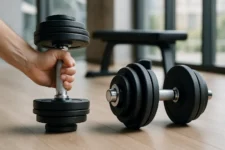
You do not buy adjustable dumbbells because you love shopping. You buy them because you want more workouts in less time, in less space, with fewer excuses. But the moment you start comparing sets, it gets weirdly specific: weight jumps, locking systems, handle feel, footprint, max load, and whether the thing will survive a real drop (or just a gentle set-down).
This is the practical, no-fluff way to decide how to choose adjustable dumbbells for your body, your training style, and your home setup – without overpaying for features you will not use.
Start with the one number that matters: your real weight range
Most people pick adjustable dumbbells based on the heaviest number on the box. That is backwards. The smarter move is to map your current working weights and your next 6-12 months of progression.
If you are building a base (new to lifting, coming back after a break, or pairing strength with weight loss), a set that tops out around 40-55 lb per dumbbell often covers a lot. If you are already training seriously, especially with presses, rows, Romanian deadlifts, or goblet squats, you will appreciate 70-90 lb per dumbbell. If your legs are strong and you plan to do heavy dumbbell squats, split squats, and hinges, higher max loads matter fast.
Here is the trade-off: higher max weight usually means a bulkier handle area, a larger footprint in the cradle, and a higher price. If your goal is consistent training and progressive overload, the “right” max weight is the one that keeps you from stalling – not the one that looks most impressive.
Make it personal: identify your top 6 lifts
Before you pick a system, think about the lifts you will actually repeat:
Chest press or floor press, one-arm row, shoulder press, RDL, goblet squat or split squat, curls and triceps work. Your adjustable dumbbells should feel good across those movements. A set that is fine for curls but awkward for presses is not a win.
Decide how fast you need to change weights
Adjustable dumbbells are either a joy or a speed bump. The difference is weight-change speed.
If you train with straight sets and longer rest, slower changes are tolerable. If you do supersets, circuits, drop sets, or time-based workouts, slow adjustments kill momentum. That is not a small annoyance – it changes your entire program.
Dial-style systems are generally quick for frequent changes. Plate-loaded adjustable handles are slower but can feel more “classic” and can be easier to expand over time (depending on the system).
Be honest about your style. If your ideal session is 30 minutes before work with supersets, prioritize speed. If your ideal session is heavier strength work with longer rest, prioritize stability and maximum load.
Understand weight increments (this is where progress lives)
Weight jumps are the hidden deal-breaker.
Smaller increments (2.5-5 lb changes) are gold for upper-body lifts. Shoulder presses, lateral raises, curls, and triceps work respond well to small jumps because form breaks down quickly when you leap too far. Larger jumps are usually fine for lower-body lifts and rows, where you can progress in bigger steps.
If a set forces you to jump 10 lb at a time, you might plateau early on certain movements. On the flip side, ultra-fine increments can cost more and sometimes reduce max weight.
A practical compromise is a system that gives you smaller jumps in the lighter range (where you need them most) and larger jumps as the weight climbs.
Choose the feel: handle thickness, knurling, and balance
Two adjustable dumbbells can have the same numbers and feel completely different.
Handle thickness matters more than people expect. A thicker handle can be comfortable for presses and rows, but may fatigue your grip sooner on high-rep work. If you already do a lot of pulling (rows, RDLs) or you plan to add loaded carries, a handle that feels secure and not overly slick is a real performance feature.
Knurling is personal. Aggressive knurling locks you in when your hands sweat, but can be harsh for high-volume training. Light knurling is friendlier but may require chalk or more grip focus.
Balance also changes the experience. Some systems place more bulk near the ends or have a longer overall length. That can make overhead presses feel unstable and can bump your thighs on certain rows. If you are shorter, or you train in tight spaces, shorter dumbbell length can be a comfort upgrade.
Pick your locking and safety standard (especially if you train hard)
Different systems secure weight differently: internal locking, pins, twist collars, or plate mechanisms. What you care about is confidence.
If you are going heavy or training close to failure, you want a mechanism that does not rattle, loosen, or shift mid-set. “Good enough” becomes a problem when you are pressing overhead or doing heavier rows.
Also consider who else might use the set. If multiple people in the house will train, a simpler adjustment system reduces user error. If you are the only user and you love traditional lifting, you might accept a slightly slower system for a more solid, classic feel.
Think about where they live: space, flooring, and storage
Adjustable dumbbells save space, but not all of them save the same kind of space.
Some systems have a larger base or cradle and require a clean footprint to re-rack safely. Others store more like a pair of standard dumbbells and a small plate area. Measure the space where you will actually use them – not the space where you wish you had a full home gym.
Flooring matters too. If you train on hardwood or in an apartment, you will want a protective mat and a system that you can set down without drama. Many adjustable sets are not designed to be dropped. If you do movements where you might bail (heavy presses, snatches, certain complexes), you either need to change the movement selection or choose equipment that matches that reality.
Match the dumbbells to your training goals
This is the easiest way to stop overthinking.
If your goal is fat loss, conditioning, and “get it done” workouts, prioritize fast changes, moderate max weight, and comfort. You will get more sessions in when the gear feels frictionless.
If your goal is muscle gain, you need enough max load to keep progressing on presses and pulls. You also need increments that let you add weight without wrecking form.
If your goal is strength, stability and maximum load rise to the top. You will care less about lightning-fast changes and more about a locked-in feel and predictable balance.
If your goal is general wellness and consistency, buy the set that you will actually use three times a week. That usually means a reasonable weight range, easy adjustments, and a setup that does not require moving furniture every session.
Check compatibility with a bench and the rest of your setup
Adjustable dumbbells do not live alone. They interact with your bench, your rack (if you have one), and your available range of motion.
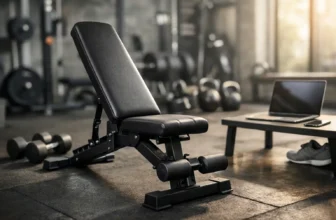
If you plan to do presses, incline work, and supported rows, a stable adjustable bench is the quiet multiplier. If your bench is narrow or wobbly, even great dumbbells will feel awkward. Also consider whether the dumbbells are comfortable to rest on your thighs for dumbbell bench press setup. Bulky ends can make that start position annoying.
If you are building a cart-friendly home setup, this is also where a “one-stop” shop can help. When you can pair dumbbells with a bench, mats, and recovery tools in the same order, you reduce friction and usually find better bundle-style savings. If you want to browse adjustable dumbbells alongside benches, plates, and training accessories under deal-focused sections like Trending and Best Sellers, you can do it at FitwellGoods without bouncing between a dozen stores.
Budget like a lifter: pay for what affects training
Price differences come from max weight, speed of adjustment, materials, and how refined the mechanism is.
If you are deciding where to spend, prioritize the features that change your workouts: weight range that prevents stalling, increments that keep progress smooth, and an adjustment system that matches your training pace. Cosmetics, ultra-premium stands, or extra accessories are nice, but they will not matter if the weight jumps are wrong or the set feels unstable.
Also think about the cost of replacing an undersized set. Buying “cheap now” can become “expensive twice” if you outgrow it in a few months.
Common mistakes that lead to buyer’s remorse
The most common mistake is buying for an imaginary version of your training. If you say you will lift heavy but you actually do circuits, you will hate slow changes. If you say you will do high-rep conditioning but you secretly want to get strong, you will outgrow a low max weight fast.
The second mistake is ignoring increments. Progress is not just motivation – it is math. When the next jump is too big, you either grind ugly reps or you stop progressing.
The third mistake is assuming all adjustable dumbbells can be treated like hex dumbbells. Many cannot be dropped. If your training style includes frequent set-downs, quick transitions, or the occasional miss, pick movements that match your equipment or pick equipment built for that behavior.
A quick self-check before you click “Add to Cart”
If you want a simple decision filter, answer these three questions:
What is the heaviest weight you will realistically use in the next year for presses and rows? How often do you need to change weights mid-workout? Do you care more about compact storage or a traditional dumbbell feel?
When those answers are clear, the “best” option usually makes itself obvious – and it is rarely the most expensive one. It is the one that makes training feel easy to start and hard to quit.
Choose a set that makes you want to grab the handles again tomorrow, because consistency is the only feature that never goes out of stock.










&url=https://fitwellgoods.com/shop/activewear/mens-activewear/mens-track-jackets/puma-mens-track-jacket-graymedium/&media=https://m.media-amazon.com/images/I/41odnAoHoKL._SS1024_.jpg)


