
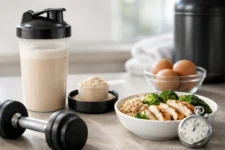
If you train hard, hit your sets, and still wonder whether your shake needs to land 15 minutes after your last rep, you are asking the right question. Protein timing for muscle gain gets a lot of hype, but the real answer is more useful than the old locker-room rules: timing helps, but it does not outrank your daily protein intake, your training quality, or your recovery.
That is good news for busy schedules. If you are balancing work, commuting, home workouts, or packed gym sessions, you do not need a perfect feeding clock to build muscle. You do need a smart routine you can repeat, because consistency beats nutrition theater every time.
Protein timing for muscle gain: the big picture
Muscle growth depends on muscle protein synthesis staying high often enough over time. Resistance training turns that signal on. Protein gives your body the amino acids it needs to actually build tissue. Timing matters because your body responds to both the workout and the protein you eat around it, but the effect is strongest when the basics are already in place.
The first basic is total daily protein. If you under-eat protein across the day, perfect timing will not save the result. Most active adults trying to gain muscle do well around 0.7 to 1.0 grams of protein per pound of body weight per day, depending on training volume, calorie intake, and how lean they are. Someone cutting calories while trying to hold onto muscle may need to stay toward the higher end.
The second basic is meal distribution. Your body seems to use protein best when intake is spread across several meals instead of being crammed into one giant dinner. That means protein timing for muscle gain is less about one magical post-workout shake and more about giving your muscles repeated chances to recover and grow.
Is the anabolic window real?
Yes, but not in the dramatic way social media sells it. The old version said you had to slam protein immediately after training or lose your gains. That is too rigid. The more accurate version is that there is a broader anabolic window that stretches across the hours before and after your workout.
If you ate a solid protein-rich meal one to three hours before training, you are already covered during and after that session. If you trained fasted or several hours after your last meal, then getting protein in soon after lifting makes more sense. The point is not panic. The point is coverage.
For most people, a practical target is 25 to 40 grams of high-quality protein within a couple of hours after training, especially if the pre-workout meal was light or far away. That is enough to trigger a strong muscle-building response for many adults. Larger lifters, older adults, and people using mixed meals instead of fast-digesting protein may do better closer to the higher end.
What to eat before and after training
Pre-workout nutrition should help performance first. If your session suffers, your muscle-building stimulus suffers too. A meal with protein and some carbohydrates one to three hours before lifting works well for most people. Protein supports muscle repair, and carbs help fuel hard training.
If you train early and cannot handle a full meal, a lighter option can still work. A quick protein source plus easy carbs is often enough to improve the session. This is where convenience matters. The best plan is the one you will actually use on your busiest mornings, not the one that looks perfect on paper.
Post-workout, focus on protein first and then let the rest of your day do the heavy lifting. You do not need a sugary recovery formula every time unless you are training again soon or your total calories are low. A normal meal with protein, carbs, and some fluids usually covers recovery well. If real food is not practical, a protein shake is a fast, effective backup and often the simplest move for people trying to stay on target.
How often should you eat protein?
A strong setup for muscle gain is three to five protein feedings across the day, each with enough protein to matter. For many people, that means about 25 to 40 grams per meal, depending on body size and food choice. This pattern gives your body repeated muscle-building signals without making your eating schedule feel like a full-time job.
Spacing meals roughly every three to five hours works well for a lot of lifters. That is not because your body shuts off outside that schedule. It is because this rhythm is practical, easier to recover on, and better than accidentally going all day on low protein and trying to make up for it late at night.
A pre-bed protein feeding can also help, especially if you train hard or struggle to hit your daily total. Slow-digesting protein before sleep may support overnight muscle protein synthesis. It is not mandatory, but it is a smart add-on for people chasing every bit of progress.
Best protein sources for timing
Not all proteins perform the same way around training. High-quality protein sources with enough essential amino acids, especially leucine, do the best job of stimulating muscle protein synthesis. Whey is popular for a reason. It digests quickly, is rich in leucine, and is easy to use before or after training.
That said, whole-food protein still works. Chicken, Greek yogurt, eggs, cottage cheese, lean beef, fish, and mixed meals can all support muscle gain when the total amount is right. Plant-based athletes can absolutely build muscle too, but they may need a little more planning to hit the same amino acid quality. Soy, pea-rice blends, tofu, tempeh, and higher total servings can close the gap.
If convenience is your bottleneck, this is one place where smart shopping can speed things up. Keeping ready-to-mix protein, shaker bottles, and meal-prep staples on hand turns good intentions into actual follow-through. That is the kind of setup that keeps momentum high when your week gets crowded.
When timing matters more
There are times when protein timing for muscle gain deserves more attention. If you train fasted, do long sessions, or lift twice a day, your nutrient timing matters more because your margin for sloppy recovery is smaller. The same is true if you are dieting, already lean, or trying to maximize every percentage point of progress.
Older adults may also benefit from being more intentional. As we age, the body can become less sensitive to smaller doses of protein, so each meal may need a stronger protein hit to stimulate muscle growth. That does not mean extreme tactics. It means the basics become even more valuable.
Beginners often worry about timing too early. If that is you, focus first on total daily protein, progressive training, enough calories, and sleep. Once those are solid, timing becomes the upgrade. It is a performance multiplier, not the foundation.
Common mistakes that hurt results
The biggest mistake is obsessing over the clock while ignoring your daily total. You cannot out-time low protein intake. Another common mistake is relying on one huge protein meal at night and calling it a day. Your body is better served by multiple quality feedings instead of one all-or-nothing dinner.
Some lifters also under-eat carbohydrates around workouts, which can drag down training intensity. Protein builds the material, but your workouts create the reason to build. If your energy is flat, your training quality drops, and so can your results.
Then there is the supplement trap. Shakes are useful, but they are not magic. They work because they help you hit your numbers consistently. That makes them a great tool, not a replacement for a solid eating pattern.
A practical schedule that works
A simple muscle-gain day might look like protein at breakfast, lunch, a pre- or post-workout feeding, dinner, and an optional pre-bed serving. That could be eggs or yogurt in the morning, chicken or tofu at lunch, a shake around training, a high-protein dinner, and cottage cheese or casein later if needed.
This kind of structure fits real life. It also works whether you train at a commercial gym or in a home setup between meetings. If you want a plan that drives visible progress, build around repeatable meals, strong workouts, and convenient protein options you will actually keep stocked. That is where FitwellGoods-style goal-driven shopping makes sense: fewer gaps, less guesswork, more momentum.
The best timing strategy is the one that keeps you consistent for months, not just motivated for a week. Hit your daily protein, spread it across the day, place one solid feeding near training, and let the compounding effect do its job. Muscle gain rewards smart habits more than perfect timing, and that should feel like a win.


![[MAT NOT Included] Yoga Mat Sling, Yoga Mat Straps for Carrying, Easy-Cinch Yoga Mat Holder Strap](https://m.media-amazon.com/images/I/31DnCdRvySL._SS300_.jpg)








,%20Yellow,%209-inch&url=https://fitwellgoods.com/shop/speed-agility/sports-speed-hurdles/bluedot-trading-speed-agility-soccer-football-basketball-plyometric-track-running-and-all-purpose-training-equipment-hurdle-set-of-6-yellow-9-inch/&media=https://m.media-amazon.com/images/I/41Urhw-SnrL._SS1024_.jpg)


%20+%204%20Pegs%20&%20D-Rings%20Soccer%20Football&url=https://fitwellgoods.com/shop/speed-agility/sports-agility-ladders/speed-and-agility-ladder-training-equipment-yellow-12-rung-ladder-free-carrying-bag-10-speed-cones-5-orange-5-yellow-4-pegs-d-rings-soccer-football/&media=https://m.media-amazon.com/images/I/41HKtyDFXSL._SS1024_.jpg)


