
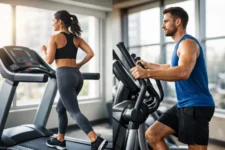
The wrong cardio machine can turn a motivated week into a dusty corner of your home gym fast. If you’re weighing a treadmill vs elliptical machine, the best pick is not the one with the flashiest console or the steepest markdown. It’s the one you’ll actually use consistently – and the one that fits your body, your goals, and your space.
For some shoppers, that means pounding out interval runs and chasing pace goals. For others, it means getting in low-impact cardio without beating up the knees. Both machines can help with fat loss, endurance, and daily calorie burn. The difference is how they get you there.
Treadmill vs elliptical machine: the big difference
A treadmill trains a more natural movement pattern. You’re walking, jogging, or running on a moving belt, which makes it the closer match to outdoor cardio. If your goal is to improve run performance, increase step count, or build tolerance for faster-paced work, a treadmill usually has the edge.
An elliptical keeps your feet in contact with the pedals throughout the movement. That reduces impact and creates a smoother stride. Most models also add moving handlebars, which brings the upper body into the session and spreads effort across more muscle groups.
So the fast answer is simple. Choose a treadmill if you want sport-specific walking or running training. Choose an elliptical if you want joint-friendlier cardio that still pushes your heart rate.
Which machine burns more calories?
This is where a lot of buyers get stuck, and the honest answer is that it depends on how hard you work. A treadmill often wins on top-end calorie burn because running is demanding. If you regularly do higher-speed intervals, incline walks, or steady-state runs, you can rack up serious output.
But an elliptical is not automatically the lighter workout people assume it is. If you use the handles actively, keep resistance up, and avoid coasting, it can deliver a challenging full-body session. Many people simply undersell the effort on an elliptical by letting the machine carry the movement.
The better question is not which machine can burn more calories in theory. It’s which machine lets you train hard and train often. If running leaves you sore or inconsistent, the treadmill’s calorie advantage may disappear over time. If the elliptical helps you hit five sessions a week without dreading them, that consistency can beat occasional all-out treadmill workouts.
Treadmill vs elliptical machine for weight loss
For weight loss, both can work. The machine matters less than the routine you can repeat.
A treadmill can be a strong pick for people who like measurable progress. Speed, distance, incline, and pace are easy to understand. That makes it simple to build structured workouts and steadily increase difficulty. Walking workouts also have a low barrier to entry, which matters if you’re just getting started.
An elliptical can be better for people who want hard cardio without high impact. If excess body weight, old injuries, or joint sensitivity make running uncomfortable, the elliptical often feels more approachable. The lower-impact motion can help you stay active while keeping recovery manageable.
If fat loss is your top goal, think bigger than one machine. The best setup usually combines cardio with strength training, recovery tools, and nutrition support. That’s where a category-driven shop like FitwellGoods can make the decision easier – you can build around your goal instead of buying one isolated product and hoping it solves everything.
Joint impact and comfort matter more than most buyers think
This is often the deciding factor.
Treadmills create impact, especially once you move from walking to running. Modern cushioning helps, but you’re still loading your ankles, knees, hips, and lower back more than you would on an elliptical. For healthy users, that is not necessarily bad. Impact can support bone health, and many people enjoy the real-world feel of walking or running. But if your joints already complain after workouts, a treadmill can become a tough sell.
Ellipticals are generally easier on the body. Because your feet stay planted on the pedals, there’s less pounding and less abrupt force with each stride. That makes the elliptical a popular choice for older adults, beginners with a lot of weight-loss ground to cover, and anyone returning after an injury.
There is a trade-off, though. Some users find the elliptical’s motion less natural, especially on cheaper models with awkward stride mechanics. If the movement feels forced, your hips or feet may not love it. Comfort always comes down to the specific machine and your body mechanics.
Which muscles do they work?
A treadmill leans heavily into the lower body. Your calves, hamstrings, quads, and glutes all get work, with more glute and posterior-chain demand when incline increases. Your core also helps stabilize you, especially during faster efforts.
An elliptical also trains the lower body, but it often spreads the work differently. Depending on resistance, incline, and stride pattern, you’ll feel quads and glutes prominently. If you use the moving handles with intent, your shoulders, arms, chest, and back join the effort too.
That does not mean the elliptical replaces strength training. It just gives you a more total-body cardio pattern. If you like workouts that feel efficient, that can be a strong advantage.
Space, noise, and home-gym practicality
For home use, the best machine is the one that fits your real life.
Treadmills usually demand more floor space and more ceiling clearance, especially for taller users. They also tend to be louder. Walking is manageable, but once you start running, belt noise and foot strike can be an issue in apartments or shared homes.
Ellipticals can still be large, but many feel quieter in use. They also avoid the repetitive pounding noise of treadmill running. If you train early in the morning or late at night, that can be a real quality-of-life upgrade.
Maintenance matters too. Treadmills often require belt care, lubrication, and occasional adjustment. Ellipticals have moving parts as well, but many users find day-to-day upkeep a little less demanding.
Who should choose a treadmill?
A treadmill is a smart buy if you want cardio that feels familiar and easy to program. It’s especially strong for walkers, joggers, runners, and anyone training for road races or outdoor fitness events.
It’s also a good fit if you like simple progress markers. Seeing your pace improve or your incline walks get easier can be highly motivating. For time-crunched professionals, that matters. You want a machine that turns on fast, gets the job done, and shows you clear wins.
The treadmill is usually the better choice if you:
- Want to train specifically for walking or running
- Enjoy intervals, incline work, or pace-based sessions
- Prefer straightforward workout tracking
- Don’t have major joint discomfort with impact
Who should choose an elliptical?
An elliptical makes sense if comfort and consistency are the priority. It’s one of the best cardio options for getting your heart rate up while keeping impact lower.
It’s also appealing if you get bored easily with basic walking. The arm action and resistance options can make workouts feel more dynamic, and many users enjoy the full-body rhythm once they settle into it.
The elliptical is usually the better choice if you:
- Need lower-impact cardio for knees, hips, or back
- Want a smoother motion for longer sessions
- Like the idea of upper- and lower-body involvement
- Prefer cardio that feels challenging without running
If you’re torn, ask these four questions
Start with your body. If running bothers your joints, the elliptical gets the early advantage.
Then look at your goal. If you’re training for steps, pace, or real-world running performance, the treadmill is the more direct tool. If you mainly want calorie-burning cardio you can recover from easily, the elliptical may fit better.
Next, think about motivation. Some people love the simplicity of pressing start and walking. Others find treadmills repetitive and do better with the varied feel of an elliptical. Honesty beats aspiration here.
Finally, think about your home. Space, noise, budget, and who else will use the machine all matter. The best-value buy is the one that gets used by you or your household week after week.
A cardio machine should make progress easier, not more complicated. Pick the one that matches your body and your habits, then build around it with the gear, recovery support, and training essentials that keep you moving forward.


![kiido Macrame Yoga Mat Carrying Strap [MAT NOT Included], Hand Woven Multi-use Strap/Carrier for Your Yoga Mat, Exercise Mat](https://m.media-amazon.com/images/I/31Z-x6stGjL._SS300_.jpg)




%20+%204%20Pegs%20&%20D-Rings%20Soccer%20Football&url=https://fitwellgoods.com/shop/speed-agility/sports-agility-ladders/speed-and-agility-ladder-training-equipment-yellow-12-rung-ladder-free-carrying-bag-10-speed-cones-5-orange-5-yellow-4-pegs-d-rings-soccer-football/&media=https://m.media-amazon.com/images/I/41HKtyDFXSL._SS1024_.jpg)


,%20Deep%20Purple&url=https://fitwellgoods.com/shop/yoga/yoga-foam-wedges/gaiam-yoga-block-wedge-lightweight-eva-foam-yoga-wedge-for-wrist-and-lower-back-support-slant-board-for-comfortable-yoga-poses-and-angles-20-l-x-6-w-x-2-h-deep-purple/&media=https://m.media-amazon.com/images/I/31WEWZtPUWL._SS1024_.jpg)
%20–%20Practice%20Tool%20for%20Infield%20and%20Agility%20Training&url=https://fitwellgoods.com/shop/speed-agility/sports-reaction-balls/softball-agility-trainer-reaction-ball-1-pack-practice-tool-for-infield-and-agility-training/&media=https://m.media-amazon.com/images/I/41RaLcaNCbL._SS1024_.jpg)