
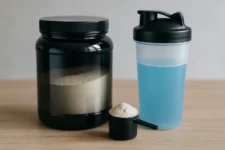
That moment when you know you should train – but your energy feels stuck in second gear – is exactly why pre-workout exists. Maybe it hits at 6 a.m. before work, or at 7 p.m. when the day has already taken its toll. A pre-workout supplement is designed for that gap between “I want results” and “I actually feel ready to perform.”
What is pre workout supplement?
A pre-workout supplement is a product you take shortly before training to support workout performance. Most formulas aim to improve one or more of the following: energy, focus, muscular endurance, “pump” (blood flow), and perceived effort so hard sets feel more doable.
The key thing: pre-workout isn’t a magic switch that creates fitness. It’s a tool that can make your sessions higher quality when your sleep was short, motivation is low, or you’re trying to push progression on a consistent plan.
You’ll see pre-workouts sold as powders you mix with water, ready-to-drink cans, capsules, and sometimes stimulant-free versions for people who train late or are sensitive to caffeine.
What a pre-workout can actually do (and what it can’t)
When people say a pre-workout “works,” they usually mean they felt more alert, pushed an extra rep, or stayed on pace longer. That is a real win – because progress often comes from small performance edges repeated weekly.
At the same time, pre-workout can’t replace the basics. If you’re chronically under-sleeping, under-eating protein, skipping warm-ups, or changing programs every two weeks, no scoop is going to outmuscle that. Think of pre-workout as an accessory – like lifting straps or a quality pair of trainers – helpful when the foundation is already in place.
The main ingredients you’ll see (and why they’re there)
Pre-workout labels can look like chemistry homework. But most formulas revolve around a few familiar categories, with different doses and add-ons.
Caffeine: the headline driver
Caffeine is the most common performance ingredient because it reliably increases alertness and can improve training output for many people. It can make heavy sets feel less crushing and help you stay engaged through longer sessions.
Trade-off: more caffeine isn’t always better. Too much can cause jitters, elevated heart rate, anxiety, or a post-workout crash. It also can mess with sleep – and poor sleep is a direct hit to recovery, appetite control, and strength gains.
Beta-alanine: the “tingles” ingredient
Beta-alanine is often responsible for the tingling or itching sensation some people feel (usually in the face or hands). That sensation is harmless for most users, and the ingredient is typically included to support muscular endurance in higher-rep efforts.
Trade-off: the tingles can be distracting. If you hate that feeling, you may prefer a formula without it or one with a smaller dose.
Citrulline (often citrulline malate): blood flow and pump support
Citrulline is used to support nitric oxide pathways that relate to blood flow. In real-life gym terms, this is the ingredient people associate with pumps and sometimes improved performance in sustained efforts.
Trade-off: pump-focused formulas can feel great, but they’re not the same as strength progression. If your main goal is one-rep max performance, you may still want a balanced formula rather than a “pump only” blend.
Creatine: performance over time, not instant hype
Some pre-workouts include creatine, which supports repeated high-intensity efforts and helps many people build strength and lean mass over time when paired with training.
Trade-off: creatine doesn’t need to be taken right before training to work. Many lifters take it daily at a consistent dose. If your pre-workout doesn’t include it, that doesn’t make the pre-workout “bad.” It just means you can stack creatine separately if you want that benefit.
L-theanine and focus blends: smoother drive
Some formulas pair caffeine with L-theanine, or include other focus-support ingredients, aiming for clean energy that feels more “locked in” and less wired.
Trade-off: focus blends vary a lot. If a label hides behind a proprietary blend, you may not know if the effective ingredients are meaningfully dosed.
Electrolytes and hydration support
If you sweat heavily, train in a warm garage gym, or do long conditioning sessions, electrolytes can help you feel more stable and less “flat.”
Trade-off: electrolytes don’t replace daily hydration habits. They’re most noticeable when you’re already pushing sweat volume.
Pre-workout timing: when to take it
Most people take pre-workout 20-40 minutes before training. That window gives stimulant-based formulas time to kick in and lets you start your warm-up as the effects build.
If you’re training late afternoon or evening, timing becomes personal. If caffeine keeps you up, a stimulant-free option can be the difference between a great session and a ruined night of sleep. For many lifters, protecting sleep is the bigger “performance hack” than adding more stimulants.
How to choose the right pre-workout for your goal
The best pre-workout isn’t “the strongest.” It’s the one that matches your training style, your caffeine tolerance, and your schedule.
If your goal is fat loss or recomposition
You’ll probably like a pre-workout that supports energy, focus, and adherence. When calories are lower, training can feel mentally harder. A moderate stimulant dose and a clean feel matter more than a mega-stim formula that spikes and crashes.
Also consider what you’re stacking. If you’re already using a weight-loss or keto system with stimulants, doubling up can be too much. This is one of those “it depends” scenarios where less is often smarter.
If your goal is muscle and strength
Look for performance support that encourages higher-quality sets: caffeine you can tolerate, plus training-support staples like citrulline and optionally creatine.
If your training is heavy and low-rep, you might care more about focus and drive than extreme pump. If you train with higher volume, pump and endurance support may feel more useful.
If your goal is cardio, HIIT, or classes
You’re often balancing energy with comfort. Too much stimulant can feel rough when your heart rate is already high. Many cardio-focused athletes do well with moderate caffeine, hydration support, and a formula that doesn’t upset their stomach.
Who should be cautious (or skip it)
Pre-workout is not a must-have for everyone. If you’re sensitive to stimulants, pregnant or nursing, managing blood pressure concerns, or taking medications that interact with caffeine or stimulants, talk with a qualified clinician before using a stimulant-based pre-workout.
And if you’re new to training, you might not need pre-workout yet. Beginners get fast results from consistency, basic nutrition, and learning good form. A pre-workout can be added later as a convenience tool once training is already a habit.
Smart ways to start without overdoing it
If you’re trying pre-workout for the first time, start with a half serving and assess how you feel during training and later that night. Pay attention to sleep quality, appetite changes, and any “wired but tired” feeling.
Avoid stacking multiple stimulant products on the same day unless you’re very confident in your tolerance and total caffeine intake. Coffee plus pre-workout plus a fat-burner can quietly turn into a lot.
A good rule is to choose control over chaos: the best pre-workout routine is one you can repeat 4-5 days a week without wrecking recovery.
What to look for on the label
Marketing names can be loud. The label tells the truth.
Prefer products that clearly list doses for key ingredients rather than hiding everything in a proprietary blend. Also check servings per container and caffeine per serving so you know what you’re actually buying and how to use it.
If you want the “pump” feel without a stimulant hit, choose a stimulant-free option and save caffeine for earlier in the day. If you want all-around support, pick a balanced formula and avoid chasing the most extreme dose just because it sounds intense.
If you like browsing by goal, it helps to shop where pre-workouts sit next to recovery, protein, and performance essentials so you can build a simple stack without overcomplicating it. You can do that in one place at FitwellGoods by shopping the sports nutrition categories alongside training gear.
Pre-workout vs. the basics: the simplest “stack” that wins
Pre-workout works best when it’s supporting habits that are already moving you forward: a repeatable program, enough protein, and a realistic sleep routine. Add a warm-up that raises your heart rate and primes your joints, and you’ll often feel the pre-workout effects more cleanly because your body is actually ready to train.
If your workouts are inconsistent, the most effective move isn’t a new flavor or a stronger scoop. It’s choosing a plan you can stick to, setting your training time like an appointment, and using pre-workout as a cue that tells your brain, “We’re doing this now.”
Your best pre-workout decision is the one that makes tomorrow’s training easier to show up for – because the real edge isn’t the supplement. It’s the momentum you build when you keep your promises to yourself.












&url=https://fitwellgoods.com/shop/yoga/yoga-mat-straps/2pcs-yoga-mat-straps-for-carrying-black-and-purple-yoga-mat-strap-multi-purpose-straps-adjustable-yoga-mat-holder-sling-for-most-size-mats-yoga-mat-not-included/&media=https://m.media-amazon.com/images/I/31y-0AW2iCL._SS1024_.jpg)


&url=https://fitwellgoods.com/shop/yoga/yoga-mat-bags/magnilay-yoga-mat-bag-for-women-and-men-yoga-bag-with-pockets-and-adjustable-strap-yoga-mat-carrier-fits-mats-blocks-and-yoga-accessories-for-workouts-32l-x-9-diameter/&media=https://m.media-amazon.com/images/I/41dHLNAXX3L._SS1024_.jpg)

