
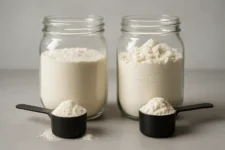
You finish a workout, you want a shake, and the tub in your cart is asking a simple question with a not-so-simple answer: whey isolate or whey concentrate?
The truth is, both can be “the right” pick. It depends on what you’re optimizing for – pure protein per calorie, budget, digestion, taste, or how your overall nutrition stack is set up. If you’re building a home-gym routine and trying to keep progress visible week to week, this is one of those decisions that can either feel effortless or weirdly annoying. Let’s make it effortless.
Whey isolate vs concentrate in plain English
Whey is a milk-derived protein that’s filtered and dried into powder. The difference comes down to how much it’s filtered.
Whey concentrate is less processed. It keeps more of the “extra” components that come along with protein – a little more lactose, a little more fat, and often a creamier taste.
Whey isolate is filtered more aggressively to remove more lactose and fat. The result is a powder that’s typically higher in protein by weight and a bit leaner per serving.
Neither option is automatically “cleaner” or “better.” They’re just different tools for different goals.
What you’re really paying for: protein density
If you look at labels long enough, you’ll see a pattern.
Concentrate commonly lands around 70-80% protein by weight, while isolate is often 85-90%+ protein by weight. That usually translates to isolate giving you a bit more protein for the same scoop size, and often fewer calories.
This matters most when you’re being tight with calories, like in a cut. If your daily target is narrow, an extra 20-40 calories per day from “small differences” can stack up over weeks.
If you’re in a gaining phase, that extra calorie difference is rarely the deciding factor. At that point, consistency and total intake are the real drivers.
Lactose and digestion: where isolate often earns its keep
A lot of people blame whey protein for stomach issues when the real culprit is lactose.
Because whey concentrate usually contains more lactose, it can be a problem if you’re sensitive. Not necessarily full-on lactose intolerant – even mild sensitivity can show up as bloating, cramps, or that “heavy” feeling that makes your shake feel like a mistake.
Whey isolate typically has much less lactose, so it’s often the smoother choice for digestion. If you’ve tried concentrate and it didn’t sit well, isolate is the most straightforward swap before you start overhauling everything.
One nuance: some people react not just to lactose, but to certain sweeteners, sugar alcohols, or gums used for texture. If an isolate still bothers you, check the ingredient panel before assuming whey itself is the issue.
Taste and mixability: concentrate can feel more like a treat
If you want a shake that tastes a little richer and feels more “milkshake,” concentrate often has the edge. That small amount of fat and lactose can improve mouthfeel.
Isolate can be thinner, especially in water. Not always – formulas vary – but if you’re mixing with water on the go, you may notice the difference.
If taste is what keeps you consistent, don’t downplay it. The best protein powder is the one you actually use five days a week, not the one that wins a label comparison and sits in the pantry.
Cost: concentrate usually wins the deal battle
In most product lines, concentrate is cheaper per serving. The filtration for isolate costs more, and you see that at checkout.
Here’s the real question: are you paying extra for something you’ll feel?
If you’re sensitive to lactose, cutting calories hard, or aiming to hit high protein while keeping food volume high, isolate can justify the premium.
If you’re simply trying to get 25-40 grams of protein into your day without overthinking it, concentrate is often the best value play.
If you like deal-forward shopping and building a cart with accessories, recovery tools, and nutrition staples, keep an eye on limited-time promos and bundles. Retailers like FitwellGoods are built for that “add a smart stack and save” approach.
The best choice by goal
If you’re cutting and chasing a lean look
When you’re dieting, you want the most protein for the fewest calories, and you usually want digestion to stay calm so you can stick with the plan.
Whey isolate often fits best here because it tends to be leaner per scoop and lower in lactose. That makes it easier to stay in a deficit while still hitting protein targets that protect muscle.
If your cut includes appetite management, isolate also pairs well with higher-volume strategies like mixing into Greek yogurt, blending with ice, or adding fiber from berries. You get protein without feeling like you “spent” your calories too fast.
If you’re bulking or training for size
If you’re in a surplus, the “slightly higher calories” of concentrate isn’t a downside – it’s barely a rounding error. In fact, the richer taste can make it easier to get your shakes down consistently.
Concentrate is often the value pick for mass phases, especially if you’re also using a weight gainer, adding oats, peanut butter, or whole milk, or building post-workout smoothies.
Isolate still works, of course, but unless your stomach prefers it or your calories need to stay cleaner, you may be paying extra for benefits you don’t fully use.
If you’re lactose sensitive or your stomach is picky
Isolate is usually the first move. It’s not magic, but it reduces one of the most common triggers.
If you’re very sensitive, you can also look for “hydrolyzed whey” (a further processed whey that’s broken down more), but many people don’t need to go that far. Start with isolate, then reassess.
If you’re an everyday, no-drama shaker
Concentrate is a strong default. It’s versatile, tends to taste better, and is easier on the budget.
If you’re just trying to nail the basics – lift 3-5 days a week, walk more, hit protein, sleep – the “best” whey is the one that supports that routine without stressing your wallet.
Timing: post-workout is less complicated than it sounds
People get intense about “fast-absorbing” protein. Whey in general digests fairly quickly compared to whole foods, and both isolate and concentrate can work post-workout.
If you trained hard and you’re not eating a meal soon, either one is a smart choice.
If you’re having a meal within an hour or two, the difference matters even less. Total daily protein and consistency beat micro-optimizing scoop timing.
Real-world label checks (so you don’t get played)
The front of the tub can be loud. The nutrition facts are quiet. Trust the quiet.
Look at protein per serving and total calories per serving. If two powders both give you 25 grams of protein but one is 110 calories and the other is 150, that’s a meaningful difference for cutting.
Then look at sugar and fat. A small amount isn’t a deal-breaker, but if you’re buying whey as a “lean” tool, you want the numbers to match the job.
Finally, check serving size. Some powders look higher-protein because the scoop is bigger. Compare grams of protein per 100 calories if you want the cleanest apples-to-apples.
A practical way to decide in 30 seconds
If you want one decision rule that works most of the time, it’s this: pick isolate when you’re optimizing, pick concentrate when you’re simplifying.
Optimizing means cutting, hitting high protein on tight calories, managing lactose issues, or wanting the cleanest macro profile.
Simplifying means you want a dependable daily protein, you care about taste, and you’d rather spend the savings on things that move the needle – better training shoes, adjustable dumbbells, a bench, or recovery gear you’ll actually use.
The closing thought
Your protein powder should feel like a helper, not a homework assignment. Choose the one that fits your stomach, your budget, and your goal for the next 8-12 weeks – then put your energy where the results come from: showing up, lifting with intent, and keeping the routine simple enough to repeat.


![kiido Macrame Yoga Mat Carrying Strap [MAT NOT Included], Hand Woven Multi-Purpose Strap/Carrier](https://m.media-amazon.com/images/I/31p8soKH-AL._SS300_.jpg)









%20–%20Soft%20Feel,%20Highly%20Absorbent,%20Quick%20Drying%20for%20Body,%20Sport,%20Yoga,%20SPA,%20Fitness%20–%20Brown&url=https://fitwellgoods.com/shop/yoga/yoga-towels/orighty-microfiber-bath-towels-pack-of-227-x-54-soft-feel-highly-absorbent-quick-drying-for-body-sport-yoga-spa-fitness-brown/&media=https://m.media-amazon.com/images/I/51iGjtXtS4L._SS1024_.jpg)


%20Microfiber%20Ultra%20Soft%20Highly%20Absorbent%20Bath%20Towel,%20Lightweight%20and%20Quick%20Drying%20Towels%20for%20Body,%20Sport,%20Yoga,%20SPA,%20Fitness,%20Grey&url=https://fitwellgoods.com/shop/yoga/yoga-towels/homexcel-bath-towel-set-pack-of-2-27-x-54-inches-microfiber-ultra-soft-highly-absorbent-bath-towel-lightweight-and-quick-drying-towels-for-body-sport-yoga-spa-fitness-grey/&media=https://m.media-amazon.com/images/I/51XnpDX64xL._SS1024_.jpg)


&url=https://fitwellgoods.com/shop/yoga/yoga-blocks/yoga-block-large-yoga-block-9x6x4-inches-sturdy-yoga-foam-blocks-high-density-non-slip-surface-for-yoga-pilates-stretching-fitness-accessories-for-stability-balance-blue/&media=https://m.media-amazon.com/images/I/31DOtliWhlL._SS1024_.jpg)

