You know that feeling when you want a workout that hits like cardio, trains like strength, and still fits into a 15-minute slot between meetings? Battle ropes are built for that exact moment. They look simple – two heavy lines and a lot of flailing – but the payoff is surprisingly specific: fast conditioning, serious core demand, and a kind of “whole-body tired” that’s hard to fake.
This is the real story behind battle ropes workout benefits: what they actually improve, why the rope makes it different than running or cycling, and how to use them without turning every session into a shoulder-smoked mess.
Battle ropes workout benefits that show up fast
The biggest reason ropes get love in gyms and home garages is that they compress a lot of training into a short window. When you drive waves into a rope, you’re producing force repeatedly, bracing your torso, and managing your breathing under fatigue. It feels like cardio, but it is not just cardio.
You can push heart rate up quickly because the movements are rhythmic and continuous, and your upper body is doing more work than it does in most conditioning options. That matters if you’re time-crunched and you want a “done in 10 minutes” finisher that still counts.
There’s also a built-in scaling effect. Move the rope faster, make waves bigger, step farther from the anchor, or switch to more demanding patterns. Same tool, different intensity, no complicated setup.
1) Conditioning without a treadmill mindset
Ropes are sneaky-good for conditioning because they keep your brain engaged. Instead of staring at pace or distance, you’re focused on wave quality, posture, and rhythm. That mental engagement helps a lot of people hold intensity longer, even when the work is hard.
Another plus: if running beats up your knees or jumping bothers your ankles, ropes can be a lower-impact way to drive a similar “lungs and legs” effect – especially when you use athletic stances, lateral steps, or squat patterns during intervals.
The trade-off is real, though. If you’re training for a specific endurance event, ropes won’t replace sport-specific volume. They’re a conditioning tool, not a mileage substitute.
2) Core strength that you feel in real life
Most rope patterns force anti-rotation and anti-extension. Translation: your core’s job is to keep you from twisting, collapsing, or arching while your arms whip the rope.
That’s why people often feel ropes in their midsection more than they expect. Your abs, obliques, and deep trunk muscles have to stabilize while your shoulders and arms repeatedly generate force. If your posture breaks, the waves get sloppy immediately – the rope tells on you.
If your goal is a stronger brace for squats, deadlifts, carries, or even better posture at a desk, ropes can be a practical add-on.
3) Shoulder and upper-back durability (when you use them right)
Battle ropes build work capacity in the muscles that keep your shoulders functioning: rear delts, lats, mid-back, and rotator cuff support. Because the rope pulls back, you’re constantly managing deceleration and re-acceleration.
But this benefit depends on technique and restraint. If you always go “all out” with shrugged shoulders and flared ribs, you’ll feel it – just not in the way you want. Keep your shoulders down and back, ribs stacked over hips, and choose intervals that let you maintain clean reps.
If you already have shoulder pain, it depends. Some people tolerate ropes well because the path is natural and you can reduce range of motion. Others aggravate symptoms by overgripping or going too heavy. When in doubt, start light and keep waves small.
4) Grip and forearm strength that carries over
Ropes are a grip endurance builder. You’re squeezing, controlling, and absorbing vibration for repeated bouts. That’s useful if you lift, climb, box, do pull-ups, or just want your grip to stop being the limiting factor on rows and farmer carries.
Here’s the nuance: rope grip strength is mostly endurance-based, not maximal crushing strength. It won’t replace heavy holds or dead hangs, but it can raise your “I can keep going” ceiling.
5) Fat-loss support through high output intervals
Ropes can support fat-loss goals because they make high-intensity intervals accessible. You can hit a big calorie burn during the session, and you can also rack up “afterburn” style effects by doing hard efforts that challenge large muscle groups.
Still, the biggest needle-mover for body composition is consistency and total weekly training and nutrition. Ropes help because they’re efficient and repeatable, not because they’re magic.
If you like deal-forward simplicity, ropes also pair well with a basic stack: a pre-workout for energy if you tolerate stimulants, electrolytes for sweaty sessions, and a recovery protein routine. Keep it simple, keep it sustainable.
Why ropes feel different than other conditioning tools
Bikes and rowers are steady, cyclical, and often leg-dominant. Ropes push more demand into the upper body and trunk while still getting your heart rate up. The “wave” also creates constant feedback – if you lose rhythm or power, you see it instantly.
Ropes also let you bias training outcomes:
- Want more power? Use shorter, harder bursts with crisp waves.
- Want more endurance? Use longer intervals with controlled breathing.
- Want more total-body fatigue? Add footwork, squats, or lateral movement.
That flexibility is a big part of battle ropes workout benefits. One tool can live in strength training, conditioning, or athletic prep.
How to start without frying your shoulders
A smart first month with ropes is not about heroic intervals. It’s about building the pattern and letting tissues adapt.
Start with 2 sessions per week. Put ropes at the end of a strength workout as a finisher, or on a standalone day when you want a quick sweat.
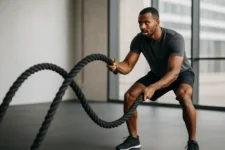
Use a stable athletic stance: feet about shoulder-width, knees soft, hips back slightly like a partial squat. Keep your torso tall, ribs down, and gaze forward. The arms move, but the core keeps your trunk quiet.
If your lower back starts to arch or your shoulders creep up toward your ears, that’s your cue to shorten the set or reduce wave size.
Simple programming that works
For most people, intervals are the sweet spot. You can keep intensity high without turning it into a form breakdown marathon.
Try 10 minutes total:
- 20 seconds work, 40 seconds rest, repeat 10 rounds.
Or if you’re more conditioned:
- 30 seconds work, 30 seconds rest, repeat 10 rounds.
Pick one pattern for the day and get good at it before you chase variety. Progress by adding a round, reducing rest slightly, or increasing wave size while staying crisp.
The best rope moves for real results
You don’t need a circus of patterns. A small menu covers most goals.
Alternating waves are the bread-and-butter for conditioning and coordination. Double waves hit power and breathing hard, and they’re great for short bursts. Rope slams (both arms) let you drive force down, which feels more “athletic” and often lights up the lats.
If you want legs involved, add a squat with double waves or step laterally while alternating waves. If you want more trunk challenge, try outside circles, but keep them controlled – circles can get sloppy fast.
Who benefits most from battle ropes
Ropes are a strong match if you’re building a home gym and want one tool that supports multiple goals, or if you’re a gym-goer who wants finishers that don’t require a machine lineup.
They’re also great for time-constrained professionals who want “minimum time, maximum sweat,” and for people who need lower-impact conditioning options.
On the other hand, if your training is highly skill-specific (distance running, cycling events) you’ll want ropes as a supplement, not a cornerstone. And if grip or shoulder tissues are already irritated, you’ll want shorter sets, cleaner posture, and more recovery between bouts.
Getting the most out of your setup
The rope you choose and how you anchor it changes everything. Longer or thicker ropes generally feel harder because there’s more mass to move. If you’re training in a garage or backyard, make sure the anchor is stable and the floor surface won’t shred the rope quickly.
If you’re shopping across gear categories, it’s easy to build a “conditioning corner” that actually gets used: ropes, a mat, maybe a foam roller for recovery, and a set of training shorts or leggings you’ll reach for every time. FitwellGoods keeps that one-stop setup mindset front and center – and if you’re browsing ropes alongside recovery and activewear, you can check what’s trending at https://fitwellgoods.com.
The best setup is the one that removes friction. If it takes five minutes to assemble, you’ll skip it when life gets busy.
A closing thought you can use tomorrow
If you want the most reliable battle ropes win, stop chasing “more tired” and start chasing “better waves.” Make every interval clean enough that you could repeat it next week with slightly less rest. That’s the kind of progress that shows up in your conditioning, your waistline, and your confidence – and it fits into real life, not just perfect training weeks.