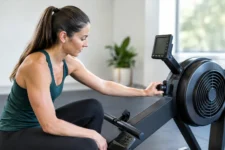
A rowing machine can feel like a full-body calorie burner or a frustrating tug-of-war, often because the resistance is set for the wrong goal. Knowing how to adjust rowing resistance helps you build stronger strokes, protect your form, and make every minute of cardio count.
The right setting is not always the highest setting. On most rowers, cranking resistance to the max can shorten your stroke, tire your lower back early, and turn a smooth conditioning session into a strength grind. The better move is matching the machine setting to your experience level, workout style, and the type of resistance your rower uses.
How to Adjust Rowing Resistance on Your Machine
Start by identifying your rowing machine’s resistance system. Air, water, magnetic, hydraulic, and hybrid rowers each create a different feel. That means the number on a dial or screen does not tell the whole story.
With any model, begin at a manageable setting and row for two to three minutes at a comfortable pace. You should feel pressure through your legs at the start of each drive, while still being able to finish the stroke smoothly with your core and arms. If you have to yank the handle, round your back, or slow dramatically after a few strokes, lower the resistance. If every pull feels too easy and you cannot raise your heart rate without racing through sloppy strokes, increase it gradually.
Think of resistance as one training lever, not the only one. You can make rowing harder by adding resistance, but also by increasing stroke rate, extending the workout, reducing rest, or improving power through your legs. This gives you far more control over your results than simply choosing the biggest number available.
Air rowers: adjust the damper, not the workload alone
Air rowers use a flywheel and fan. Many have a damper lever that controls how much air enters the flywheel housing. A higher damper setting allows more air in and makes each pull feel heavier, similar to rowing through thicker water.
The key detail: the damper does not work like a traditional weight stack. Your actual resistance also rises when you pull harder. A powerful stroke produces more drag, while an easy stroke produces less. On machines with performance monitors, this may be shown as a drag factor.
For most beginners, a damper setting around 3 to 5 is a smart starting point. Many experienced rowers also train in this range for steady cardio and intervals. Settings around 6 to 8 can work well for strength-focused pieces, but they demand clean technique. A setting near 10 is not automatically better. It may feel impressive, yet it can overload the back and make high-quality training harder to sustain.
Water rowers: control pace and water level
Water rowers create resistance with paddles moving through a tank. The feel is naturally progressive: pull harder, and the resistance rises. Many models do not have a resistance dial, so your stroke power and cadence do most of the adjustment.
The water level matters, but it is usually a less convenient day-to-day tool. More water adds baseline load; less water reduces it. Follow your owner’s manual and keep the tank within its marked fill range. Do not overfill it just to create a tougher workout.
For a more challenging session, focus on driving hard with your legs while keeping a controlled recovery on the way forward. That creates strong, repeatable power without changing the tank. For a lighter recovery row, use gentler leg drive and a lower stroke rate rather than shortening the stroke.
Magnetic rowers: use levels with intention
Magnetic rowing machines often offer numbered resistance levels, controlled by a manual knob or electronic console. These rowers tend to be quieter than air models, which makes them a strong home-gym choice for early workouts, apartment spaces, or shared rooms.
Start around a low-to-middle level, often 3 to 5 on a 1-to-8 scale or 5 to 8 on a 1-to-16 scale. Because designs vary, use your body’s feedback rather than copying a setting from another machine. Increase one level at a time, then row for a minute before making another change.
Magnetic resistance can feel consistent throughout the stroke. That is useful for controlled endurance work, but it may not perfectly mimic the increasing load of an air or water rower. If the resistance feels strong at the start but your finish becomes jerky, step down a level and prioritize a long, smooth pull.
Hydraulic and hybrid rowers: make small changes
Hydraulic rowers typically use pistons, while hybrid models combine systems such as air and magnetic resistance. Hydraulic machines may have separate settings for each arm or a central adjustment mechanism. Keep both sides even unless your manual specifically recommends otherwise.
These machines can become demanding quickly, especially as pistons warm up during a workout. Begin lower than you think you need, test your movement, and adjust in small increments. If the resistance changes noticeably from the first five minutes to the last five minutes, use effort and form as your guide rather than chasing one exact setting.
Choose Resistance Based on Your Goal
Your ideal resistance changes with the session. A setting that works for a 10-minute power interval may be a poor choice for a 30-minute fat-loss row.
For general fitness and calorie-burning cardio, choose moderate resistance you can sustain with good form. Aim for a stroke rate that feels controlled, usually around 20 to 26 strokes per minute for steady work. You should breathe hard enough to feel challenged but still be able to say a short sentence. This is where consistency wins. A repeatable 25-minute session does more for your weekly progress than an all-out five-minute battle you dread repeating.
For endurance, lower the resistance slightly and concentrate on rhythm. Your legs should drive first, followed by your torso and arms. On the way back, reverse the sequence: arms, torso, then knees. This efficient pattern protects your energy and keeps the stroke from becoming choppy.
For strength and power, raise resistance moderately and lower your stroke rate. Focus on explosive leg drive, then return with control. A useful approach is short intervals: 30 to 60 seconds of powerful rowing followed by easy recovery. Heavy resistance is only productive if you can maintain a long stroke and neutral spine.
For high-intensity intervals, moderate resistance is usually more effective than maximum resistance. You need enough load to generate power, but not so much that every stroke becomes slow. Try 20 seconds hard and 40 seconds easy, or one minute hard and one minute easy. Let your pace, heart rate, and technique determine the intensity.
Use Form to Check Whether Resistance Is Right
The machine setting is right when your body can move in the intended sequence. At the catch, your shins should be close to vertical, your arms straight, and your back braced. Drive through the legs first. When the legs are nearly straight, swing the torso slightly back, then finish with the arms pulling the handle toward your lower ribs.
Resistance is probably too high if your knees shoot down but the handle barely moves, your shoulders creep toward your ears, or you feel your lower back doing most of the work. It may also be too high if your recovery is rushed because you cannot control the handle back to the flywheel.
Resistance may be too low when you can pull quickly but feel no meaningful connection through your legs and core. Before raising the setting, make sure you are using a full stroke. Many people mistake a short, rushed stroke for easy resistance.
A Simple Progression That Works
For your first few workouts, spend 15 to 20 minutes at a moderate setting. Focus on smooth, connected strokes and finish with enough energy that you could do a little more. Once this feels comfortable, add time before adding resistance. Build to 25 or 30 minutes, then introduce one or two short intervals.
After that, increase only one variable per week: a slightly higher resistance level, a few more minutes, an extra interval, or a faster target pace. This keeps progress measurable and gives your joints, back, and grip time to adapt.
If you are building a complete home-training routine, pair rowing days with mobility work, strength training, supportive shoes, and recovery tools that help you show up consistently. FitwellGoods makes it easier to shop those workout essentials by goal, so you can build momentum without piecing your setup together from multiple stores.
The best rowing resistance setting is the one that lets you train with power, control, and enough consistency to see real change. Set it with purpose, row with clean form, and let your next workout be stronger than your last.