
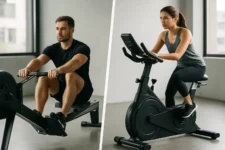
You have 25 minutes, a half-charged playlist, and one goal: get your cardio in without wasting time (or your knees). The only problem is choosing the machine that actually matches the result you want. When it comes to rowing machine vs exercise bike, the better pick is the one that fits your body, your space, and the kind of progress you want to see week to week.
Rowing machine vs exercise bike: the real difference
At a glance, both are cardio. In practice, they feel completely different. A bike is lower-body dominant and steady by nature – you can spin at an easy pace for 30-45 minutes and barely notice time passing. A rower is full-body and technique-driven – it can be smooth and meditative, but it can also humble you fast if you sprint without a plan.
The simplest way to think about it is this: the exercise bike is your “show up and go” option, while the rowing machine rewards you for learning a rhythm. Neither is better universally. They just solve different problems.
Calories and conditioning: which one works harder?
If your main question is calories, you want the honest answer: your output matters more than the machine. The same person can burn wildly different calories depending on resistance, pace, and how consistently they push.
That said, rowing tends to make it easier for many people to hit higher whole-body intensity once technique clicks. You are using legs, hips, back, and arms in a coordinated drive, so the demand can feel “total body” in a way the bike often does not. On the bike, you can absolutely reach high intensity too, especially with higher resistance or intervals, but it is easier to stay in a comfortable groove and never quite challenge yourself.
A practical way to decide: if you want fast conditioning and you like workouts that feel athletic (hard efforts with recoveries), rowing is a natural match. If you want reliable calorie burn with minimal learning curve, the bike is hard to beat.
Muscle coverage and physique goals
If you are shopping for body composition changes, this section matters.
Rowing: more total-body stimulus
Rowing is not just arms. Done correctly, most of the drive comes from the legs and hips, then you finish with the upper back and arms. Over time, that adds up to noticeable work for glutes, quads, hamstrings, lats, rear delts, and even your midline as you brace.
Rowing will not replace heavy strength training, but it pairs beautifully with it because it reinforces a powerful hip drive and builds work capacity without needing a rack or barbell.
Biking: legs-first, easy to stack with strength
The bike is primarily quads, glutes, hamstrings, and calves with less upper-body involvement. For some shoppers, that is the point. If you already lift and you want your cardio to stay out of the way, biking can be the more “recoverable” choice. You can ride the day after leg day at an easy pace and still get blood moving without feeling like your entire back and grip are involved.
If you are chasing glute and leg endurance, steady cycling sessions can be a quiet weapon.
Joint impact and comfort: what your body tolerates
Both machines are low-impact compared to running, but they stress the body differently.
A bike is usually the easiest for cranky joints. You are seated, movement is guided, and most of the load is predictable. If you have lower back sensitivity, biking often feels safer – provided the seat and handlebar setup fits you. Comfort matters here. A poor fit can cause knee irritation or hip tightness, while a dialed-in setup can feel like a cheat code for consistency.
Rowing is also low-impact, but it asks more of your hips and lower back. If you round your back or yank with your arms, you can feel it in places you did not expect. The upside is that good form is learnable quickly, and once your stroke is clean, rowing can feel smooth and joint-friendly.
If you know you are coming back from an injury or you want the lowest “friction” option for daily use, the bike has an edge. If your body feels good and you are willing to practice form, rowing is a strong long-term play.
Space, noise, and lifestyle fit
Home setups live or die by reality: floor space, storage, and how loud your workouts are when the rest of the house is sleeping.
Many rowing machines store upright, which can be a big win in apartments or shared spaces. The footprint during use is longer, though, so you need a clear lane.
Exercise bikes tend to have a smaller footprint during use, but they do not always store as neatly. On the other hand, they are often the easiest to hop on for a quick session between meetings, because you can pedal while watching a show or answering emails.
Noise depends on the resistance type, but in general, both can be apartment-friendly. If you are highly noise-sensitive, focus less on “rower vs bike” and more on the resistance style and build quality.
Learning curve and motivation: what keeps you consistent
Consistency is the real winner. The machine you enjoy enough to use three to five times a week will beat the “perfect” option that collects dust.
The bike is almost instantly intuitive. You can set resistance, pick a playlist, and start. That ease is a big deal for beginners, time-crunched professionals, and anyone who wants cardio to feel automatic.
Rowing has a skill component, but that can be motivating in its own way. You get quick feedback: your stroke feels smoother, your pace improves, and intervals become measurable. If you like seeing performance numbers climb, rowing can be addictive.
Here is the honest trade-off: biking is easier to start, rowing is often more engaging once you commit.
How to choose based on your goal
If your goal is fat loss, both work – but the best choice is the one you will do consistently and progressively. Rowing can deliver a high “bang for your minute,” while biking makes it easier to accumulate lots of weekly cardio without feeling crushed.
If your goal is better endurance for sports, rowing builds full-body power endurance and breathing control under effort. Biking builds steady aerobic capacity and leg stamina, which is perfect if your life already includes hiking, running, or lower-body training.
If your goal is stress relief and daily movement, the bike is often the more relaxing option. If your goal is feeling athletic again, the rower tends to scratch that itch.
A simple two-week test (no guesswork)
If you are stuck, run a quick experiment. For two weeks, do three workouts per week on your preferred machine style, then compare how your body feels and how likely you are to repeat it.
On a bike, try two steady rides (20-40 minutes at a pace you can maintain) and one interval session (short hard pushes with easy pedaling between). On a rower, try two technique-focused steady rows (think smooth strokes and controlled breathing) and one interval session with shorter bursts.
At the end, you are looking for one thing: which machine makes it easier to show up again tomorrow.
Shopping cues: what to look for before you buy
Choosing a category is half the battle. The other half is picking a machine you will actually enjoy using.
On bikes, pay attention to adjustability (seat height and fore-aft position), stability, and resistance range. A bike that fits you well feels better instantly and makes longer sessions realistic.
On rowers, prioritize a smooth stroke, comfortable footplates, and a monitor that gives you clear metrics like pace and strokes per minute. The better the feel, the more likely you are to row with good form instead of fighting the machine.
If you like deal-forward browsing and comparing options by category, you can explore cardio picks alongside training accessories and recovery add-ons at FitwellGoods – it is an easy way to build a full setup without bouncing between stores.
The bottom line for rowing machine vs exercise bike
Pick the rowing machine if you want full-body training, you enjoy measurable performance progress, and you like cardio that feels like a workout. Pick the exercise bike if you want the simplest path to consistency, lower-body focused conditioning, and a machine that fits into real life without extra effort.
Your best move is the one you can repeat. The more your cardio matches your personality and schedule, the faster your results show up in the mirror and on the clock – and that is the kind of momentum you can actually keep.




![Tumaz Yoga Mat Strap [MAT NOT Included] (2 Sizes) with Extra Thick & Comfy Delicate Texture, Adjustable Yoga Mat Carrier](https://m.media-amazon.com/images/I/31UF2H+dDxL._SS300_.jpg)






%20with%20Extra%20Thick%20&%20Comfy%20Delicate%20Texture,%20Adjustable%20Yoga%20Mat%20Carrier&url=https://fitwellgoods.com/shop/yoga/yoga-mat-straps/tumaz-yoga-mat-strap-mat-not-included-2-sizes-with-extra-thick-comfy-delicate-texture-adjustable-yoga-mat-carrier/&media=https://m.media-amazon.com/images/I/31UF2H+dDxL._SS1024_.jpg)


&url=https://fitwellgoods.com/shop/yoga/yoga-blocks/supportive-yoga-block-non-slip-eva-for-yoga-pilates-stretching-and-meditation-4x6x9/&media=https://m.media-amazon.com/images/I/31Ck-cLpGdL._SS1024_.jpg)
